The era of AI voice agents is not a distant future anymore; it’s here and transforming customer service. They are becoming the first point of contact for increasing support and sales calls. These systems assist, rather than replace, human agents in 2026, completing a range of tasks, including account enquiries and appointment scheduling. By 2029, agentic AI will handle 80% of routine customer service inquiries reducing the need for human intervention by approximately 30%. In any business considering this change, the issue isn’t whether the technology works. It’s how to evaluate AI voice agents against real business needs before spending money, reputation, and customer trust on them.
What Are AI Voice Agents?
AI voice agents are software programs designed to engage in conversation with customers via voice commands, natural language processing, and speech synthesis over the phone or via mobile apps. They are designed to sound and respond as though they were a person, rather than a selection of pre-recorded prompts.
How AI Voice Agents Differ From Legacy IVR Systems
The classic IVR systems have a fixed numbering system: 1 for billing, 2 for support. AI voice agents operate differently. They understand context and deal with interruptions between sentences and change their answer according to what the caller is saying, not which button they pressed. These systems can instead analyze what is being said and determine the intent from this rather than matching a script.
What Technology Powers AI Voice Agents Today
The rise of modern AI voice agents is a result of three developments. Large language models became competent enough to interact in a coherent multi-turn conversation, without forgetting the previous context. Text-to-speech began to sound authentic – natural style, pacing, and tone rather than robot-like. What was once the obvious “robotic” sound of automated calls was reduced to a minimum, leaving the systems responding almost in real time. This blend is what led from novelty demos to production deployments of millions of real calls each month.
Why Is Voice AI for Customer Service Gaining Momentum?
Voice AI for customer service is growing rapidly for a reason that every support leader is familiar with – call volume is rarely aligned with staff. More often than not, it is either during odd hours or when the volume of calls is suddenly overwhelming.
What Business Pressures Are Driving Adoption
A few forces are accelerating how quickly companies adopt AI voice agents.
- Cost Pressure. This type of automation is more cost-effective than a human call handler for an everyday request and frees funds to deal with more complicated requests that truly require a human.
- Customer Expectations. In the age of instant gratification, AI voice agents can provide immediate responses 24/7, even on weekends and holidays.
- Competitive Parity. More companies are deploying this technology successfully, and slower companies risk being left behind about response times and satisfaction scores.
- Mature Technology. Customer service Voice AI has gone beyond scripted answers to intelligent systems that can search for account information, take real actions, and escalate intelligently.
Where Voice AI for Customer Service Fits Alongside Human Teams
All of this doesn’t imply that AI voice agents will be replacing human interactions. The ones that are getting the most value use voice AI for customer service as a capacity layer to take repetitive, well-defined requests and free up time for human agents to spend on nuance, empathy, and true exceptions that require judgment. The technology is most effective when used as a filter, and not a replacement.
How to Evaluate AI Voice Agents Before You Commit
Understanding how to evaluate AI voice agents is more important than the flashiest demo in a sales demo. What might sound great in a demo can be a disaster in real-world situations if it hasn’t been tested for the real world.
What AI Voice Agent Evaluation Criteria Actually Matter
In creating rubrics for assessing AI voice agents, prioritize what you can measure, not what you can see.
- Speech recognition accuracy. The ability to recognize various accents, speech patterns, and background noise without having to have the caller repeat themselves.
- Latency and turn-taking. Is it a natural conversation, or do there seem to be awkward pauses between each response?
- Containment and resolution rate. What is the percentage of calls that it can completely resolve without contacting a human agent?
- Escalation logic. Be aware of signs of frustration or complexity, and pass the buck or get caught in a loop with the caller?
- Integration depth. Will it be able to retrieve real-time data from your CRM, billing system, or scheduling tool, or will it only return scripted responses?
- Compliance and data handling. Are there security, privacy, and consent requirements relevant to your industry?
- Voice quality and tone control. Can the brand’s tone be customized, or does it sound generic and interchangeable?
How to Test AI Voice Agents Against Real Call Conditions
Any list of AI voice agent evaluation criteria is of little value if it isn’t tested appropriately. Test real call transcriptions with AI voice agents, rather than best-case scripts. Add background noise, regional accents, and interruptions or cut-off speech from callers. The difference between a pilot that looks good in a demo and a deployment that slows a crawl as real customers call in is testing this way.
What Are the Top Voice AI Platforms for CX Built Around Today?
While there is no single “best” answer when it comes to the top voice AI platforms for CX, it will depend hugely on the volume of calls, compliance requirements, and current tech stack that a business is running.
What Architecture Traits Separate Strong Platforms
Most top voice AI platforms for CX worth serious consideration share a few traits.
- Modular design, that lets teams swap speech-to-text, language models, or voice synthesis components independently.
- Native integrations, with common CRM, helpdesk, and telephony systems instead of requiring custom middleware.
- Analytics dashboards, that surface containment rates, sentiment trends, and failure patterns, not just raw call logs.
- Multilingual support, since global customer bases expect service in their own language.
- Human-in-the-loop controls, so supervisors can monitor live calls or retrain the system based on real transcripts.
How to Shortlist Before Committing
Don’t follow the platform with the most features but outline your criteria first. Once you shortlist the AI voice agents, run tests on their call data to verify that it matches your requirements. The most promising top voice AI platforms for CX will allow you to test them before committing a long-term solution.
What ROI and Metrics Should You Track After Launch?
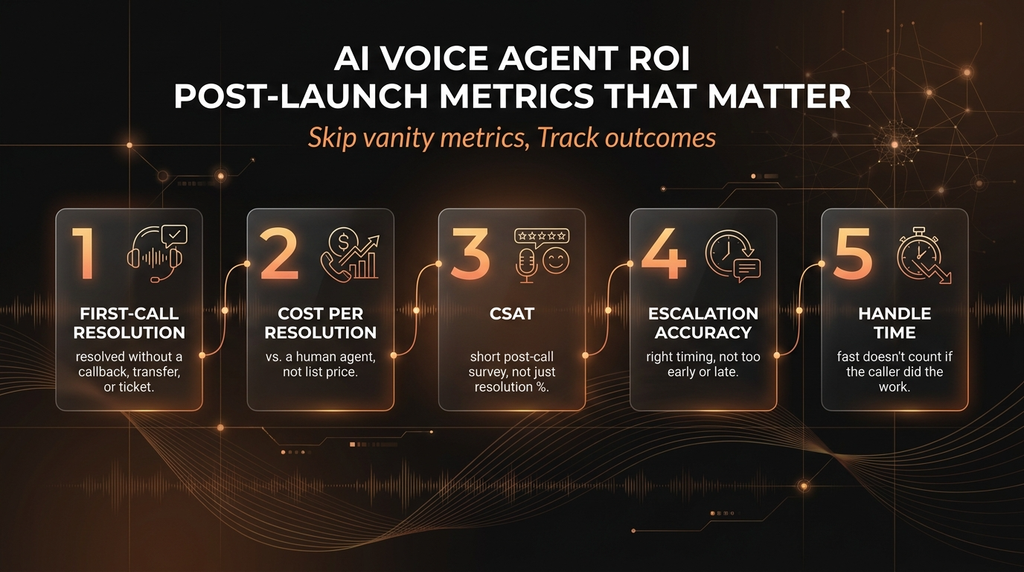
So, once it’s live, the proof of value has just begun. Vanity metrics such as number of calls served or answered may be nice to have in a slide deck but are not necessarily indicative of success in the business.
Which Metrics Actually Matter
A more transparent scorecard measures outcomes directly related to cost, satisfaction, and containment.
- First Call Resolution Rate: Percentage of calls that are resolved without a follow-up ticket, transfer, or call back.
- Cost Per Resolved Interaction: This measures the cost of a platform-based interaction as compared to a human interaction, rather than against the list price of the platform.
- Customer Satisfaction after Automated Calls: Not solely by the resolution rate, but by means of short post-call surveys.
- Escalation Accuracy: The frequency of correct escalation time and frequency, too early, too late, or no escalation at all.
- Average Handle Time: This is measured in addition to the resolution rate, because if the call is resolved quickly, but in fact by the caller, that’s not a win.
How Often Should You Review Performance
Labor savings and lower abandonment rates have helped drive ROI of more than 300% for years-long deployments cited by Forrester’s ROI research on voice automation. Those figures rely on a disciplined approach to measurement, and not a “set it and forget it, but come back in a year”. Companies that check on their AI voice agent performance at least once a month are more likely to detect issues in weeks, rather than months (due to a misunderstanding in a prompt, integration failure, or escalation nightmare).
When Should a Business Actually Deploy AI Voice Agents?
Timing matters as much as the technology choice itself. AI voice agents tend to deliver the strongest early wins in a few specific scenarios rather than across every use case at once.
Which Use Cases Work Best First
- High call volume, low complexity. Resetting a password, checking orders, and scheduling appointments are good places to start.
- After-hours coverage gaps. Voice automation can be deployed during nights, weekends, and holidays, taking some of the demand that would otherwise be in voicemail.
- Seasonal or event-driven spikes. The volume is temporary in nature, such as retail peaks, billing cycles, or service outages, and is costly to staff for the long haul.
- Multilingual demand outpacing staffing. Instant language coverage can be achieved by technology, instead of hiring specialists for each language.
What Happens When Businesses Skip Ahead
Technology that is rolled out in the most challenging, high-stakes situations the first day, without having tested less ambitious use cases first, usually isn’t performing as well as it can right from the get-go, despite initial success, and generally fails to garner much internal momentum until it begins to have some time to truly grow.
What Common Mistakes Undermine AI Voice Agent Performance?
Even if the deployment is well-funded, there are problems that could have been prevented, which have nothing to do with the technology itself.
Mistakes in Setup and Testing
- Skipping real-call testing. Demo scenarios often are not scripted and aren’t representative of how customers talk or “go off topic”.
- Underestimating integration work. If a system cannot instantly access order history or the status of an account, callers won’t be very happy.
- Overpromising to customers. Having an AI voice agent appears to be the same agent as a human one makes customers feel like they are speaking with a fast and capable, but limited, assistant.
Mistakes in Ongoing Management
- Ignoring escalation design. An inability to know when to communicate with a human is worse than no communication at all.
- Treating it as “set and forget.” Call patterns change over time, and AI voice agents require continuous tuning using new transcripts, rather than a set-up.
The answer to these pitfalls is the same as for any other discipline: setting clear criteria, honestly testing, and rolling out gradually until the results warrant it.
What Does the Future Hold for AI Voice Agents in Customer Experience?
Call volume in the contact center is increasingly being automated, and the difference between automated calls and human calls in terms of speed and availability continues to grow. See multi-step requests, voice and channel integration (such as chat, screen sharing), and account-history personalization performed by an AI-based voice agent, rather than a new caller.
So, for those businesses that are still on the sidelines, don’t feel that you need to rush to deploy because your competitors are. It’s to build a clear framework for how to evaluate AI voice agents, test against real conditions rather than polished demos, and expand only as measured results, not vendor hype, justify it.
Frequently Asked Questions
What are AI voice agents used for?
They interact with customers over the phone, answer questions, make appointments, check order status, and refer more complex transactions to human agents, all around the clock.
How do AI voice agents differ from traditional IVR systems?
AI voice agents can interpret natural speech, maintain context throughout a conversation, and engage in dynamic responses, rather than pre-programmed choices, unlike menu-driven IVR.
Are AI voice agents accurate enough for customer service?
AI voice agents perform well on simple, specific requests and can be used in many situations that will benefit from human intervention if the conversation involves complex or sensitive questions.
How much does it cost to implement AI voice agents?
The costs will vary depending on the volume of calls, the level of integration, and the platform used, but an AI-powered voice agent can handle customer inquiries at a much lower cost than a human agent’s call.