A conversational AI experience is one in which the individual interacts with an AI-powered chatbot, voice agent, or virtual agent and leaves the interaction feeling heard and not processed. It includes the natural flow of reading intentions, the speed of responses, and the human nature of communication from the initial message to resolution. Just 70% of users are expected to begin their journey with customer service using conversational AI by 2028, making this experience the focal point of the brand’s trust-building efforts. It’s a guide that explains the design principles that power this experience, as well as the ways in which UX habits and best practices ensure that it doesn’t feel like it’s run by a robot.
What Does a Conversational AI Experience Actually Mean?
The Core Definition
An NLP/Machine Learning-powered conversational AI experience is the entire experience a user will have as he or she chats or speak with a system. Coming up with the right answer is not the only way to earn points. It’s all about tone, timing, memory, and flow, making it feel like you’re interacting with a person who understands you the first time, rather than the software.
The Technology Behind It
There are three pillars to a strong conversational AI experience. Previously, natural language understanding (NLU) was used to figure out what the user intended to say, natural language generation (NLG) was used to generate a suitable response, and sentiment analysis was used to determine the emotion and sentiment behind the words. Combined, these pieces are able to maintain context from turn to turn, tailor responses to previous history, or fall back gracefully when a request strays off the script. Miss any one of these three, and the conversational AI experience starts to feel mechanical no matter how advanced the underlying model claims to be.
Why Is the Conversational AI Experience Business-Critical Right Now?
Customer expectations have changed, and they’re not going back. No one can accept a menu of pre-defined answers or options. No one can stand repeating themselves three times to get an answer. People don’t want to be dealt with in a rigid way; they want to be dealt with in a flexible way. This transition will give conversational AI an edge over product roadmap and make it a competitive advantage.
How Different Industries Use It
Conversational AI for retail relies on a solid customer experience to help products be found and abandoned carts be recovered. It enables bankers to confirm identity and respond to inquiries about their accounts without waiting in line. It can be used for triage symptom checks with healthcare providers and scheduling appointments at hours other than regular office hours. For travel companies, it is utilized for real-time flight rebooking and answering questions about bags. In all cases, regular interactions are delegated to AI, providing humans with the time to interact with customers who really need them.
What Happens When the Experience Is Done Poorly
A bad chatbot can have a negative impact on trust as much as not having a chatbot at all. There’s nothing that irks customers more than having to explain things to an AI system over and over again that just doesn’t seem to hear them, and a less-than-competent conversational AI experience is the first impression that a brand will give. That’s where good conversational AI design and disciplined UX for conversational AI step in to make a moment that slowly seals a loyal customer. That’ll just cost the company customers who are sure to switch to a competitor with a smoother one.
What Are the Elements of a Great Chatbot Experience?
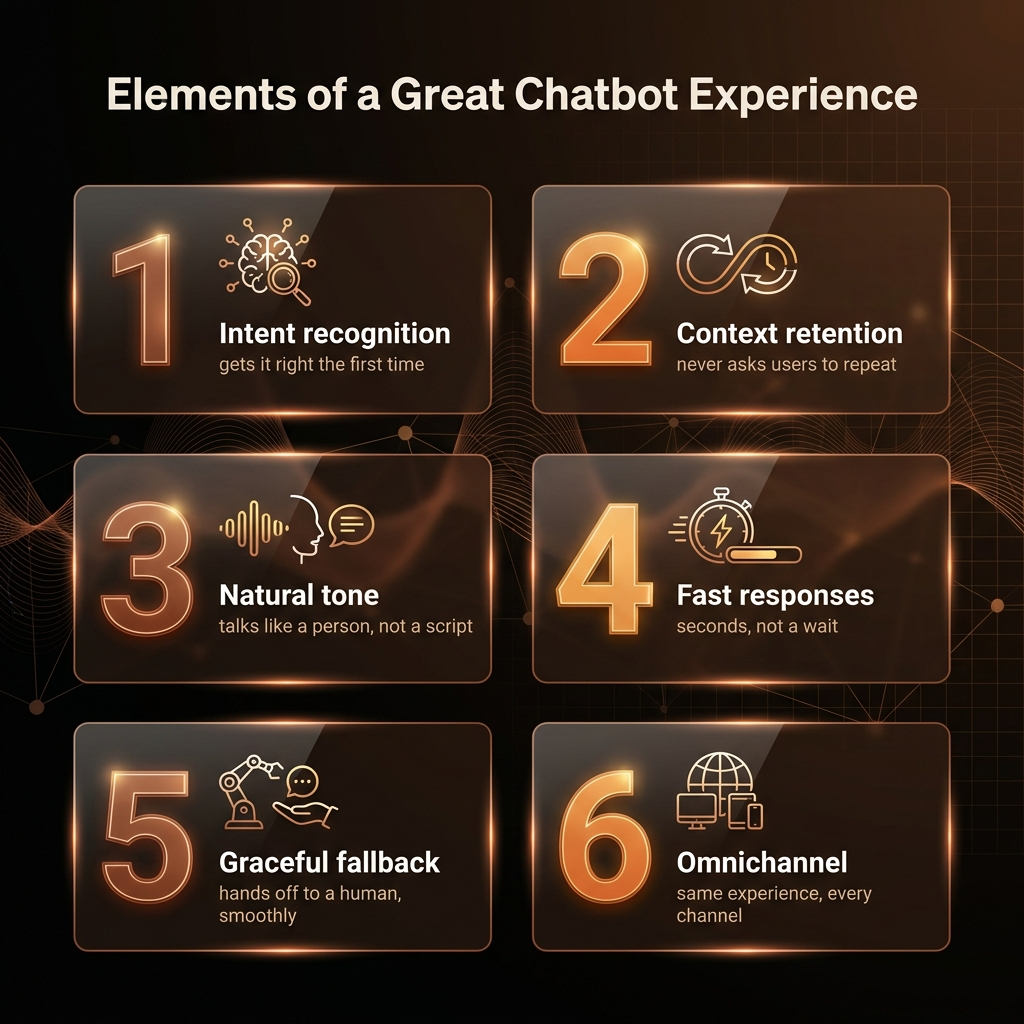
But not all chatbots create a great chatbot experience, even those that are based on a powerful AI model. Technology itself will not make usable. Great chatbots have the following components.
Core Elements Checklist
- Clear intent recognition: the system understands the intent of the user in the first message without requiring the user to rephrase.
- Context retention: keeps track of previous parts of the conversation and never asks the user to repeat themselves.
- Natural tone: responses are conversational, not robotic, overly formal, or cut-and-pastes.
- Fast response times: anything over a couple of seconds and it isn’t a live conversation.
- Graceful fallbacks: if the AI doesn’t know, it provides suggestions or transitions effortlessly to a human agent.
- Omnichannel consistency: the conversational AI experience is consistent across all channels, whether the user is on a website, an app, or a messaging platform such as WhatsApp.
Why Missing Even One Element Hurts
All these aspects play a crucial role in creating the user experience they leave with when interacting with conversational AI, and any of these can offset the benefit of the others. “Speed but amnesia” or “friendliness but slow” is not a satisfactory “bot”. This is the very same checklist teams are looking at today before any significant release, hence the fact that it is being used as a benchmark.
What Does Good Conversational AI Design Actually Look Like?
Design Principles Before a Single Line Is Written
A good conversational AI design starts with writing the first sentence of dialogue. It starts with laying out what the user wants, the use cases of the conversation, and establishing, prior to the interaction, what parts of the conversation the AI should escalate to a human. Designers construct sample dialogues, try edge cases, and improve tone guidelines to ensure that the personality remains consistent in both cases, e.g., a query for an order status and a sensitive billing dispute.
Planning for Failure States
A good conversational AI design is also one that anticipates failure—it’s not just about what’s going to go right. So, what happens after three incorrect answers from the AI? What is one to do when one asks something totally beyond their remit? It is better to plan these moments before launching the bot, instead of fixing them after the fact as they become apparent, because this is what makes thoughtful design different than a bot that works but just grinds on silently and isn’t enjoyable for the person who depends on it. This type of planning is a key part of a resilient conversational AI experience, as most real conversations go to “off script” at some point.
Poorly Designed vs. Well-Designed Bots
| Poorly Designed Bot | Well-Designed Bot |
| Repeats the same generic reply regardless of input | Adapts responses based on context and history |
| Forces users through rigid menu trees | Understands free form, natural language |
| Goes silent or loops when confused | Escalates smoothly to a human agent |
| Feels identical across every channel and use case | Adjusts tone and detail to the platform and situation |
Visual and voice cues matter too. Typing indicators, quick reply buttons, and confirmation messages all reduce ambiguity and help interactions feel more predictable and trustworthy. Small details like these rarely get noticed when done right, but they are felt immediately when missing.
How Do You Apply UX for Conversational AI?
Applying the principles of good UX to conversational AI involves using the same tools as are used to create effective UX for traditional interfaces, but instead of screens and buttons, it is working with dialogue.
Practical UX Guidelines to Follow
- Design for the first five seconds. Once you begin an interaction, users make a decision very quickly on whether it is helpful or not.
- Write for the ear, not just the eye. Even if the bot is a text bot, it should be natural and sound natural when spoken aloud.
- Limit choices per turn. Giving too many options to users is like having a poorly designed IVR system.
- Build in progress cues. Designers may find something intuitive, but a first-time user, without context, may not.
- Test with real users, not just internal teams. Individuals switch topics in the middle of a text, and a good system should be able to cope with topic changes without losing the flow of the text.
- Design for interruption. Let’s delve deeper into why UX in Conversational AI is more important than scripting.
Why UX for Conversational AI Matters More Than Scripting
Getting UX for conversational AI right is less about clever scripting and more about respecting how people communicate, in short bursts, with interruptions, and with the expectation of being understood the first time, not the third. Applying UX for conversational AI consistently is what elevates a basic chatbot into a conversational AI experience people actually choose to return to.
What Are the Conversational AI Best Practices to Follow?
After launch, a few conversational AI best practices keep things fresh and vibrant, rather than deteriorating over time.
Ongoing Habits Worth Building
- Audit conversations regularly. Analyze the report results to identify where users are frustrated, have trouble understanding the information, or are experiencing the same issue.
- Update training data continuously. Language changes and slang, new product names, and customer questions change every quarter.
- Personalize without overreaching. Relay information and make appropriate adjustments based on the data available without invading or being too familiar.
- Keep human handoff seamless. Pass the entire conversation context on to agents so users never have to repeat themselves.
- Measure the right metrics. While containment rate is important, it is not as crucial as resolution quality, first contact resolution, or actual customer satisfaction.
- Localize thoughtfully. A literal translation of a chatbot does not convey cultural nuances, humor, and idiom.
Continuously following these conversational AI best practices is what keeps the conversational AI experience moving from great to great, after the initial launch hype and team transition to the next project. Transcripts will begin to exhibit these conversational AI best practices in a matter of weeks if they aren’t followed.
What Mistakes Quietly Undermine the Conversational AI Experience?
Avoidable and repeated mistakes can ruin the conversational AI experience, even when it is well funded.
Common Pitfalls to Avoid
- Over promising capability. A bot that claims to be “AI-powered” is essentially a decision to tree if it is not. If it’s not, then it’s a decision tree, and marketing it as such sets expectations that won’t be met.
- Ignoring escalation paths. No clear exit path to get to a human quickly leads to loss of trust, quickly or permanently.
- Neglecting tone consistency. A bot that is cheerful in one reply and clinical in the next feels disjointed.
- Skipping post launch iteration. Seeing the day of launch as the end of continuous improvement and not the beginning.
- Optimizing only for cost. The tactic of going for containment rather than solving the customer’s problem comes back to haunt you in a hurry.
One error at a time, every error above erodes the quality of conversational AI experiences over time. If you avoid these pitfalls, it can prevent it from turning into another abandoned automation project that slowly nibbles away at customer patience.
What’s Next for the Conversational AI Experience?
The next level of conversational AI’s journey from answers to agents is towards anticipating needs and performing multi-step tasks autonomously. Voice, text, and visual interfaces are becoming more and more interdependent, and users can alternate between typing and speaking without losing the context of the conversation.
What’s next is being defined by multimodal capability, the increasing integration with backend systems, and the increased transparency of AI (systems that explain what they are thinking or that raise questions and uncertainty rather than simply guessing silently). Established brands that continue to evolve a good conversational AI design and conversational AI UX today will be much more successful when it comes to leveraging conversational AI without fresh development in the years to come. It’s not a project that happens once and then we’re done. It’s not a project that runs one time and then we’re done. It’s a continuous process of listening, testing, and tweaking the way users and AI systems communicate, quarterly.
Conclusion
The conversational AI experience is no longer just a side feature. It is becoming the standard way to access support, ask questions, and get things done. As expectations have increased year after year, it takes more than just plugging in a language model to get it right; it takes the elements of a great chatbot experience, consistent conversational AI best practices, and continuous investment in UX for conversational AI. Design/Testing/Iteration will be an iterative process, not a one-time project launch activity, and that’s how teams will keep up with the technology trajectory of becoming more proactive and agentic. This conversational AI experience will be what brands must have in order to be trusted by customers when the next wave of conversational technology comes.
FAQs
What is a conversational AI experience?
A conversational AI experience refers to how natural the AI-driven chatbot or voice assistant is in understanding, reacting, and addressing user requests.
How is conversational AI different from a basic chatbot?
Basic chatbots act on a set of rules, whereas conversational AI is based on NLP and machine learning, which interpret the intent, resulting in a more natural and adaptive conversational AI experience throughout queries.
What makes a good conversational AI experience?
A successful conversational AI experience will be quick, accurate, retain context, maintain a natural tone, and seamlessly hand off to a human agent when necessary.
Why do businesses prioritize the conversational AI experience?
Conversational AI experience is a top priority for businesses as it saves support costs, accelerates resolution, and influences customers’ brand perception of reliability.