Voice activity detection (VAD) is a method that determines if a stream of audio contains human speech or only silence and background noise frame-by-frame. It’s used by voice AI systems to identify when a person begins speaking, when they end speaking, and which audio should be processed. If done right, it lowers the cost of transcription, helps to increase the accuracy of recognition, lowers the number of false triggers, and makes it easier for the user to interact with AI agents in a natural manner. This guide covers voice activity detection meaning, how it works, the primary approaches, real-world applications, and how it ties into turn detection, so you understand how one small component affects the whole voice experience.
What Is Voice Activity Detection and Why Does It Matter?
The same difficulty arises with each voice product. Microphones are on, but people don’t talk to someone all the time. Whether it’s a call, meeting, or AI conversation, these will all feature speech, pauses, breathing and room noise, which needs to distinguish the valuable information from the noise. Voice activity detection takes on that task. It is at the beginning of the audio path, and all the following elements are dependent upon it. The cost of contact center agents will be saved at $80 billion by conversational AI, and each of these automated calls will start with a system computing when the caller is talking.
Voice Activity Detection Definition
The typical voice activity detection definition is a method of signal processing that tags each tiny section of audio as speech or non-speech. Most engines will give a yes/no flag or a probability percentage between 0 and 1, and it is up to the application to determine what probability is considered speech.
VAD Meaning in Plain Language
The VAD meaning is easiest to remember as a “speech or not” switch. You’ll also see it called speech activity detection or plain voice detection. The voice activity detection meaning stays the same under every name: the system answers one question, which is whether someone is speaking right now.
Voice Activity Detection vs. Related Technologies
It helps to separate VAD from the tools it’s often confused with:
- Wake word detection is the ability to hear one particular phrase, for example, “ Hey Siri.”
- Speaker recognition is the process of determining who is speaking.
- Speech recognition translates spoken text into typed text.
- Voice activity detection only indicates if speech is present or not.
How Does Voice Activity Detection Work?
Voice activity detection can be broken down very simply at a high level: it examines very small pieces of audio as it is played, and assigns a score to each piece that represents how likely it is to be speech. The process is very easy to explain, but the details are what determine if a voice product is smooth or frustrating.
The Basic Processing Pipeline
Most voice activity detection systems follow the same five steps:
- Capture: Microphone captures an uninterrupted audio stream.
- Framing: The stream is divided into frames, typically a few tens of milliseconds in length.
- Feature extraction: Every frame is converted to features, such as energy distribution or patterns of the spectra.
- Classification: A rule or model used to determine if a frame contains speech.
- Smoothing: Frames adjacent to the noisy one are compared so that one ‘noisy’ frame does not cause the result to be changed.
Smoothing matters more than it seems, because people pause mid-sentence and take breaths. Engines add a little padding before detected speech and wait briefly after it ends, so the first syllable isn’t clipped, and the last word isn’t cut off.
Key Settings That Shape VAD Behavior
OpenAI’s real-time API documentation lists three controls for its default server VAD mode:
- Threshold: If set high, it will require more noise to activate, which can help in noisy environments. A lower one will pick up subtle voices but will alarm.
- Prefix padding: Audio was retained from just before speech was detected, thus resulting in the first word remaining.
- Silence duration: The length of time that must pass before the speaker is deemed to be at the end. The shorter the response, the quicker the reply and the more likely it is to interrupt.
The sample configuration has prefix padding of 300 milliseconds and silence of 500 milliseconds, giving the impression of the time scales involved.
What Are the Main Types of Voice Activity Detection?
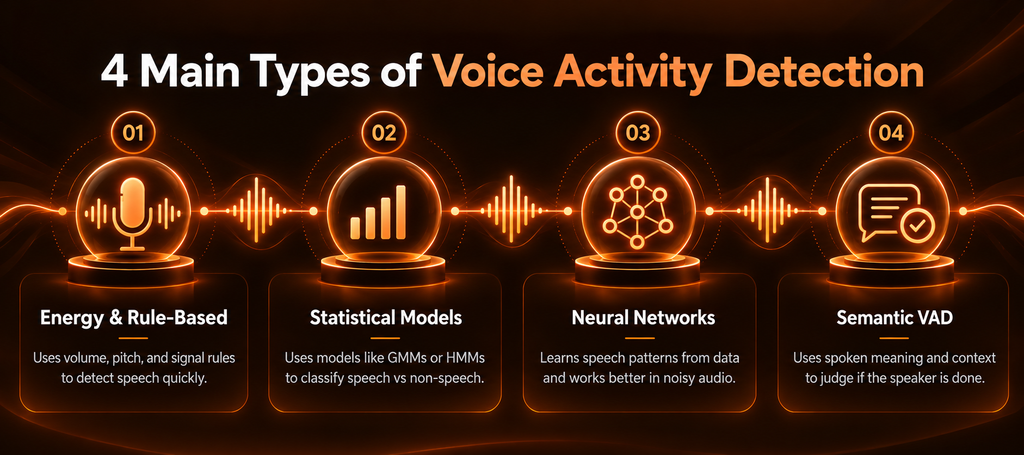
Rules have been replaced by neural networks and now by models that understand language. One generation replaces simplicity with accuracy, and the correct choice is determined by the product.
| Approach | How it decides | Strength | Weak spot |
| Energy and rule-based | Volume, zero-crossing rate, pitch | Very light and fast | Struggles in noise |
| Statistical models | Gaussian mixture or hidden Markov models | Cheap and well understood | Lower accuracy in tough audio |
| Neural networks | Patterns learned from large audio datasets | Robust across noise and accents | Needs care to run efficiently |
| Semantic | Uses the words spoken to judge if the speaker is done | Fewer mid-sentence interruptions | More complex to set up |
Traditional Rule-Based Methods
Traditional voice activity detection leans on hand-built signals. Speech is usually louder than silence, sits in certain frequency ranges, and carries pitch, so engineers wrote rules around those traits. WebRTC’s VAD is the best-known example. These methods are fast and tiny, but a cough or background music can fool them.
Deep Learning Models
Neural voice activity detection skips the hand-written rules and learns what speech looks like from thousands of hours of real audio. Open-source options such as Silero VAD and TEN VAD are popular here. Many developers assume neural models are too heavy for real-time work, yet Picovoice’s benchmarks show Silero VAD using well under 1% of a CPU.
Semantic VAD
The newest approach looks at what was said, not just how loud it was. OpenAI’s semantic VAD mode uses a classifier to estimate whether a user has finished speaking, based on their words. Trailing off earns a longer wait, while a clear closing statement gets a quick reply. This is where VAD starts to overlap with turn detection.
What Is Turn Detection and How Does It Differ From VAD?
What is turn detection? It’s the process of deciding when a speaker has finished their turn, and the system should respond. VAD reports sound or silence, while turn detection asks a harder question: is this pause the end of a thought, or just someone gathering their words?
Turn Detection Meaning in Voice AI
Take a caller who says, “I’d like to book a table for…” and then stops to check with a friend. A system that only listens for silence hears two seconds of quiet and starts talking. So what is turn detection doing differently? It notices the sentence is unfinished and waits.
Signals Behind Turn Detection
Turn detection normally builds on voice activity detection and then layers on more signals:
- Adaptive silence timers that change with context instead of one fixed value
- Semantic cues from the words spoken so far
- Intonation, since a falling pitch often signals a finished thought
- Barge-in handling, so the agent stops talking when the user interrupts
- Back-channel filtering, so “uh-huh” doesn’t derail a reply
Why VAD Quality Shapes Turn Detection
Get VAD wrong, and turn detection has nothing reliable to build on. Get it right, and the conversation flows.
Where Is Voice Activity Detection Used?
The same technique shows up in more places than most people realize. Any product that listens to people talk, from a smart speaker to a call recorder, uses some form of voice activity detection to decide what is worth processing.
Voice Assistants and AI Agents
After a wake word, VAD tracks when the user starts and stops a command, so the assistant can respond promptly and save power.
Contact Centers and Call Analytics
VAD flags when customers and agents begin and end speaking. Picovoice notes that roughly half of a typical call can be silence, which is why speech-to-silence ratios show up in call analytics.
Transcription and Speaker Diarization
Only speech segments go to the speech-to-text engine, which cuts cost. A one-hour recording may hold just 10 to 15 minutes of real speech, according to Picovoice’s guide. In diarization, VAD marks the speech blocks first, and later models work out who said what.
Telecom and Video Conferencing
Silence doesn’t need to be transmitted, so VAD helps save bandwidth on calls and meetings.
Why Is Voice Activity Detection Hard to Get Right?
Almost any VAD will work in a quiet room (good microphone). Life is more complex; voice activity detection must deal with sounds that sound more like speech.
Common Real-World Challenges
- Background noise such as air conditioning, traffic, and music.
- High-pitched sounds like coughing, laughing, and mouth sounds.
- Distance and echo of the far-field microphones and reverberant rooms.
- Compression quality isn’t good, the sample rate is too low, and the equipment is too low quality.
The Sensitivity Trade-Off
The more sensitive a VAD, the more real speech that it detects, but also the more junk it fires. Stricter and it won’t recognize the trash but might not recognize the soft-spoken customer. This is measured by teams using the true positive and false positive rates, typically on an ROC curve, and then selecting a threshold for the product. If it goes wrong, users feel it: the speech is cut off mid-word, awkward pauses in the stream of conversation, an assistant that responds to a door slam.
How Can You Choose a Voice Activity Detection Engine?
Choosing a voice activity detection engine is basically a few questions worth pondering. Answer them on your own sound, not a vendor demo.
Evaluation Criteria
- Accuracy: check detection and false alarm rates in noise like yours.
- Latency: real-time agents can’t wait around.
- Footprint: model size, CPU and battery use matter on mobile and embedded devices.
- Platform support: web, mobile, server, and edge each differ.
- Maintenance: documentation, licensing, and update frequency all count.
Testing Best Practices
Test using various speakers, accents, and production conditions such as whispering and shouting, then continue to monitor during production. The accuracy of the lab is not the same as in the real-world environment.
What Does the Future of Voice Activity Detection Look Like?
There are already a number of trends here, and they all seem to be moving in the same direction: the clearer and clearer the boundary between speech detection and conversation understanding becomes.
Context-Aware Detection
Now semantic models will evaluate whether someone has completed their thought or not, instead of responding on sound alone.
On-Device Processing
The trend is towards more processing taking place on the device, partly due to latency requirements and privacy considerations.
Built-In Platform Support
VAD is becoming an integral part of speech-to-speech platforms. For example, OpenAI’s real-time API removes the need to do so, as the feature is enabled by default in speech-to-speech sessions.
What Should You Take Away About Voice Activity Detection?
Voice activity detection may seem like a minor technicality, but it can make all the difference in the world when it comes to how each voice experience is perceived. It communicates to a system what to listen to, what to do, and when not to listen or do. There are still roles for traditional approaches; neural approaches are much more effective at dealing with “messy” audio, and semantic approaches are moving VAD towards real turn detection. When creating or testing something that receives speech input, look at the accuracy and responsiveness of the first decision: separating speech from all other sounds. Use it with real audio, adjust the thresholds for your scenario, and make it an integral part of the experience.
Frequently Asked Questions About Voice Activity Detection
What is voice activity detection in simple words?
Voice activity detection is a technology that indicates whether or not a person is talking. It can distinguish speech from silence or background noise and process only the useful sounds.
What does VAD mean in AI?
Voice activity detection (VAD). In the realm of AI systems, it can identify when a human is talking, thereby enabling speech recognition systems to listen and respond to the user.
Is VAD the same as speech recognition?
Speech recognition is a different thing from No. VAD merely senses if speech is present in the audio stream or not; speech recognition makes the speech into text. Typically, the voice system first detects speech with VAD, and then feeds it to speech recognition.
What is turn detection in voice AI?
When a speaker is done speaking, it is determined by turn detection, which allows the AI to respond. It is an extension of VAD with pause timing and meaning that decreases interruptions and awkward silences.