Voice AI latency is the time between the caller finishing a sentence and the AI agent responding. It accumulates in the voice activity detection (VAD), speech recognition, language model processing, speech synthesis, and network transport modules. Most production agents take more than a second, whereas humans take about 200ms. Less than 800 milliseconds is natural, and more than 1.5 seconds means callers hang up. This guide discusses the possible reasons for latency, how to measure end-to-end latency, what low-latency voice AI is, and how to reduce voice AI latency, from streaming to speech-to-speech models. Consider latency a key metric for voice AI.
What Is Voice AI Latency and Why Does It Matter?
Voice AI latency refers to the delay between the end of an agent’s thought and the time a caller hears the agent’s response. It may seem like a minor detail, but it can make the difference between a successful call and a failed one. Let’s take a closer look at what this involves and its significance.
How Callers Experience Voice AI Latency
Imagine if you called a service hotline and heard 3 seconds of silence. You ring, and you ask “hello?” and you think “did it drop?” The delay is the time between a person’s last word and the first word of their response. This number is called direct, and failing to meet this number is interpreted as failure, not thinking time.
The Human Benchmark Behind Voice AI Latency Targets
People typically start speaking within 200 milliseconds after the other person completes their turn. When an agent takes 1.5 seconds, the interaction is not only slow, but broken as well. Callers talk over the agent, repeat themselves, or press zero to talk to one of the agents. Voice AI latency is therefore no longer just an IT engineering concern but a metric for the quality of a product.
Where Does Latency in AI Voice Agents Come From?
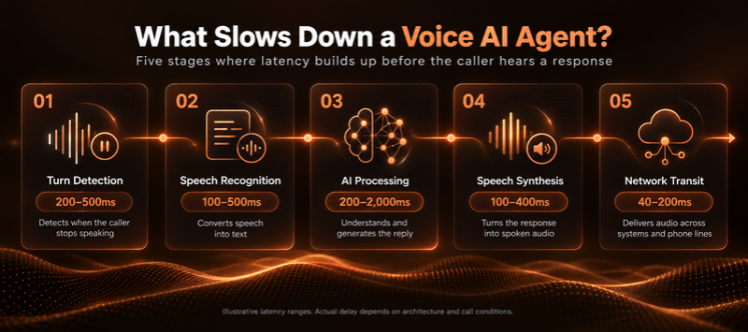
A voice agent isn’t a single system. It is a relay race, and the latency is the total time of all the runners in the race – voice AI latency. The time lag of AI voice agents accumulates gradually, and each step has an average range.
Turn Detection and Voice Assistant Latency
First, the system needs to determine that the caller has stopped talking. VAD detects voice and silence, and endpointing determines the meaning of pauses. This step introduces an additional 200 to 500ms latency and is generally one of the larger and less talked-about latency contributors from the voice assistant.
Speech Recognition and Language Model Delays
Streaming speech-to-text takes approximately 100 to 200 milliseconds per sentence, while batch transcription waits for the entire sentence and can take up to 500 milliseconds per sentence. The language model is the largest: 200 to 2,000 ms (directed by the size of the model and prompt). Typically, large reasoning models are too slow for live calls.
Speech Synthesis and Network Transit
The extra time added by text-to-speech is 100 to 400 ms, but streaming synthesis can begin playing the first clause before it finishes. Network hops introduce a latency of 40 to 200ms and phone lines introduce a latency of 200 to 500ms which cannot be removed by software. The teams that track down voice AI latency piece by piece typically discover the source of latency in 2 or 3 locations, rather than five.
How Do You Measure End-to-End Latency Voice AI Callers Actually Feel?
Teams get it wrong at the measurement stage. The objective is to record what the caller hears, not what one component reports. Defining the definition and the percentiles is the first step in controlling voice AI latency.
Metrics That Define End-to-End Latency Voice AI Teams Track
Begin the clock when the caller ceases talking and stop when the agent’s first sound is heard. That is what end-to-end latency voice AI teams should report, and it must include the turn-detection wait. Then, using component metrics, you determine the cause of the delay:
- Time to first token (TTFT): how fast the language model starts answering.
- Time to first audio (TTFA): how fast playable speech reaches the caller. Vendors define it differently, so ask where the clock starts.
Why Percentiles Beat Averages for Voice AI Latency
This means that with an average of 900 ms, one out of every ten callers might still have to wait more than three seconds. Reporting p50 for the typical call and p90/p95 for the slow calls that cause hang-ups. Also measure on real phone calls since the overhead of telephony is never present in the lab and can significantly affect your numbers for latency for voice AI calls.
What Counts as Low Latency Voice AI?
There’s no official standard for low-latency voice AI, but the industry has settled on rough zones. They work best as guides for planning, not as guarantees. Here’s how to read them and how to turn them into a working budget.
Benchmark Zones for Low Latency Voice AI
Under 800 ms feels natural. Between 800 and 1,500 ms is acceptable for simple tasks, but callers notice. Above 1,500 ms, the experience drops sharply, and interruptions begin. Reality is less kind. One analysis of more than four million production calls put the median for cascaded systems at 1.5 to 1.7 seconds. Vendor claims like “sub-200 ms” usually describe one component, not what the caller hears. So when you compare voice AI latency across vendors, ask for mouth-to-ear numbers on real calls and p95 targets in writing.
Building a Voice AI Latency Budget
A budget keeps voice AI latency in check. Pick a total target, say 800 milliseconds, and split it across the pipeline: 200 for turn detection, 100 for recognition, 250 for the model’s first token, 100 for synthesis, and 150 for the network. These numbers are illustrative. Phone calls add carrier overhead, so leave headroom, and track the budget on every release, because a prompt change can quietly eat 200 milliseconds.
How Does Voice Activity Detection Shape Response Speed?
VAD is the first gate in the pipeline, and it quietly sets the pace for everything after it. A slow or jumpy gate inflates the total delay before the model has even seen a word. Getting it right is one of the cheapest wins available.
VAD and Endpointing Explained
Voice activity detection listens for speech versus silence. Endpointing is the next step, where the system decides whether a pause means “I’m done” or “I’m thinking.” Set it too cautiously, and you add 400 ms of dead air to every turn. Set it too eager, and the agent cuts in while someone reads a ten-digit account number.
Tuning Voice Activity Detection for Lower Latency
Default settings are conservative, so tune them for your use case. Use models that read context instead of just silence, and add rules for numbers, dates, and addresses. Well-tuned VAD can remove hundreds of milliseconds of voice AI latency without a faster model, and it moves you closer to low latency voice AI.
How Can You Reduce Voice AI Latency?
There’s no silver bullet, but a few moves deliver most of the gains. Start with architecture, then work through the tactics in order. Teams that reduce voice AI latency for good usually redesign the flow instead of shaving milliseconds off each part.
Start With the Right Architecture
Latency in AI voice agents is capped by architecture before any tuning begins. A strictly sequential pipeline has a ceiling that tuning can’t break. Cascaded designs run each stage in sequence, so delays add up. Parallel designs overlap work, which is how sub-500 ms responses become possible. Overlap the stages first and polish second.
Tactics That Cut Voice AI Latency Fastest
- Stream every stage. If the caller takes too long to write the output, feed it to the model so it can begin writing before the caller is done and so that speech begins on the first clause. The voice AI latency can be reduced by 500 ms or more by streaming.
- Right-size the model. A small model processes billing checks or bookings in 1/10 of the time of the first token.
- Colocate services. Persist WebSocket or WebRTC connection(s) for running the model and synthesis in one cloud region.
- Parallelize lookups. Pre-warm compute; run CRM and compliance runs when the model is generating.
- Mask unavoidable waits. A response of “let me check that” will ease their mind as well as make it seem like the exchange happened faster since they were interrupted mid-sentence.
- Measure after every change. If you are doing a fix that affects the median, consider doing a test on the tail, as they may be negatively affected.
Does Speech-to-Speech Latency Beat the Traditional Pipeline?
To achieve reduced voice AI latency, speech-to-speech models are capable of eliminating the pipeline by converting text to speech in a single step. The issue is whether that speech-to-speech latency benefit is greater than the trade-offs. It is dependent on your call type and control.
Why Speech-to-Speech Models Respond Faster
The speech-to-speech models do not go through the step of writing the text. Audio is fed in, audio is fed out: no federation between different recognition, language, and synthesis services. This eliminates the inter-stage delay and brings a speech-to-speech latency well below most cascaded stacks, resulting in a smoother felt experience in demos and ideal for low-latency voice AI applications.
Trade-Offs Teams Should Weigh
The catch is control. With a cascaded pipeline, you will have a text in the middle, space for logging, compliance checking, and fixing errors. Unified models do not show that step, are more expensive per minute, and do not have as many customization options. Hybrid designs are becoming more common, with lots of reasoning and reasoning tools in one layer, and a single audio layer for natural delivery. In either case, try testing voice AI latency on your own calls since claims of speech-to-speech latency don’t always reflect your traffic, accents, and phone routes.
Why Does Voice Assistant Latency Hurt Business Results?
Slow responses are not just a pain in the ass. They transform results – ranging from finished calls to customer satisfaction. Voice assistant latency is not obvious either, so the impact is often not felt until it comes to churn.
Costs of Poor Voice Assistant Latency
A long silo is like being put on hold, and callers who already had to wait in a queue don’t have much patience. Voice AI latency can be seen in the following three places:
- Abandonment: callers hang up or call back and press zero.
- Escalation costs: every call handed to a human cancels part of the savings.
- Trust: customers rarely blame the technology. They blame the brand.
Why the Damage Stays Invisible
A call can be logged as resolved while the customer walks away annoyed. Teams that take voice AI latency seriously track tail percentiles and caller sentiment, not just containment.
What Should You Take Away From All This?
In voice automation, quick replies will not be a luxury. They differentiate a legitimate chat from a dropped telephone call. Firstly, track end-to-end latency (as experienced by voice AI callers) on actual calls, not the average latency. Then process through the pipeline: fine-tune your voice activity detection, stream each step, right-size your models, and keep your services close together. Test speech-to-speech, where applicable, and prepare for graceful pauses for waits that cannot be eliminated. While voice AI latency is not zero, with proper design, it can be reduced to below the threshold that the caller is able to detect. If this is done correctly, then the technology is ready to be spoken to.
Frequently Asked Questions
What is a good voice AI latency?
The optimal voice AI latency is below 800 milliseconds, after which the first sound is heard from the bot. After 1.5 seconds, the conversation becomes nearly broken.
What causes latency in AI voice agents?
The latency is caused by delays in turn detection, speech recognition, model processing, speech synthesis, and network transmission. Each stage is slower and slower with sequential pipelines, oversize models, and servers that are far away.
How can you reduce latency in voice AI?
Run all stages of a stream, adjust the VAD and endpointing settings, use a smaller model for simple tasks, deploy services to one region, and perform lookups in different regions at the same time as the model is generated.
Are speech-to-speech models faster than cascaded pipelines?
Usually, yes. The speech-to-speech models eliminate the hand-off between stages and decrease SSTL. The cost, the lack of control over the conversation logic, and the limited customization options are usually the trade-offs to cascaded pipelines.