Today, businesses face a deluge of repetitive customer calls and overstuffed support queues that can’t be solved by hiring more agents. A voice agent powered by AI is software that listens to, understands, and responds to calls end-to-end in natural human speech, without a human agent in the loop. It can carry out real conversations, interact with business systems, and even make appointments, billings, and solve problems on its own—all without the stiffness of phone menus. Conversational AI deployments will reduce contact center labor costs by $80 billion in 2026, a sign that voice AI for business is no longer optional for enterprises trying to scale. In this blog, you’ll find out how they work, how they compare to older systems, what features are important in a platform, and how to successfully build and launch them.
What Is an AI Voice Agent and Why Does It Matter for Enterprises?
An artificial intelligence voice agent is an independent software application that leverages the power of speech recognition, natural language understanding, and/or text-to-speech technologies to engage in goal-oriented telephone conversations and perform the correct action or actions in the absence of human intervention. Not only does it read from the scripted answers, it thinks about what the caller wants, reads data from systems linked to it, and does things.
For enterprises, this practically translates into three shifts:
- Customers’ calls are answered directly without having to wait in a queue for a person to answer.
- Support is available 24 hours a day and without the need to hire more staff or put on extra hours.
- All transactions are recorded, written down, and standardized within regions and across shifts.
The transition from simple phone trees to a voice agent is a basic transition. A phone menu points the way. A voice agent provides. That gap is the very reason for the rapid enterprise uptake in the last two years.
How Do AI Voice Agents Work?
To get started, it’s imperative to understand how AI voice agents are designed to function – the reliability of the way it is built will hold in real calls, not merely at a vendor demo.
Most platforms have a pipeline that operates as follows:
- Speech-to-text (STR) allows users to dictate text as they speak, including accents, noise, and interruptions.
- Natural Language Understanding (NLU) reads the text to pick up on the intent of the caller, not just keyword matches.
- Dialogue management is used to determine what action a system should take or what it should say next, according to the context, business rules, and conversation history.
- Backend Integration connects CRM, ERP, scheduling, or ticketing systems to fetch and update on the backend during the call.
- Text to Speech (TTS): Provides natural-sounding speech with appropriate pacing for the system’s response.
After these 5 stages are optimised, the entire loop runs in less than a second, and it is felt as if there is a real conversation. That’s the reason as well why enterprises asking better questions during vendor evaluation is made easier by understanding how AI voice agents work: it’s at the integration step (stage four) that most implementations fail.
What Is the Difference Between an AI Voice Assistant and a Voice Agent?
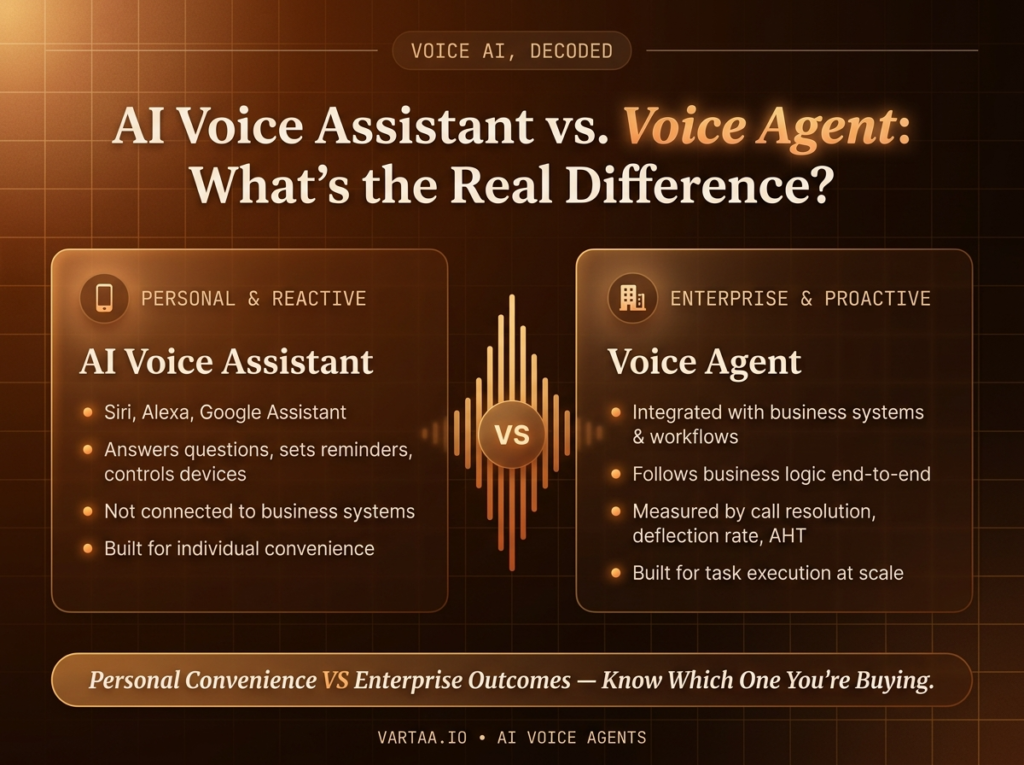
The AI voice assistant vs voice agent distinction matters more than most enterprise buyers realise, and mixing them up leads to buying the wrong product entirely.
AI voice assistant – Siri/Alexa/Google Assistant is meant for personal and reactive use. Solves problems, reminds you, and regulates devices. It is not integrated with enterprise systems, a multi-step workflow, or it acts on behalf of a business.
The platform is developed with a focus on business results. It is tied to real systems used for operation, adheres to business logic, and is measured through metrics such as call resolution, deflection, and average handle time rather than just understanding what was said. The AI voice assistant vs voice agent is personal convenience versus enterprise task execution – that is where every enterprise customer that is considering purchasing a voice solution should begin.
What Is the Difference Between IVR, Conversational AI, and a Voice AI Agent?
The one aspect of enterprise telephony that is often confused is the difference between IVR, conversational AI, and a voice AI agent, and knowing the difference can determine which technology addresses the problem.
IVR (Interactive Voice Response) works on menus. Press 1 for Billing, 2 for support. It cannot listen to natural speech, adapt mid-call, nor can it get access to data from live businesses. It’s not what callers want, due to its infrequent use of real need.
Conversational AI can comprehend and react to natural speech. A big leap from IVR, but in many deployments, it is only able to answer questions instead of performing tasks in the backend systems.
A voice AI agent is the amalgamation of both: natural language understanding and autonomous task execution. It doesn’t only inform the customer that the order is delayed; it re-schedules the delivery, updates the record, and sends a confirmation. The difference between IVR, conversational AI, and a voice AI agent comes down to whether the system can only talk or whether it can actually do something.
Enterprises are missing out on potential customers by the day due to friction and dead ends on IVR. Users of conversational AI who are not fully integrated are answering questions, but not solving problems. A full-fledged AI voice agent serves to plug them both.
Why Is Voice AI for Business a Strategic Priority in 2026?
In the last three years alone, voice AI has emerged from experimentation and become a key part of business infrastructure. It’s because there is no drop in calls, customers have become a lot more impatient, and human agents have become a lot more expensive.
Voice AI for business takes care of all three:
- Speed: routine calls completed with no hold time in 2 minutes or less.
- Performance: No additional staff required to support thousands of concurrent calls
- Consistency: same level of response for all callers—at desk or in field.
- Data: All phone calls are recorded, indexed, and product/service improvement can be executed based on the data.
Voice AI in the business sector can be applied to different business areas – retail, healthcare, banking, logistics, etc. The common denominator is any business that has a lot of incoming calls and the same types of requests in the same manner.
What Makes the Best AI Voice Agents Different from Average Ones?
Not every platform works the same, and there are significant differences in the quality of the implementations. The superior AI voice agents do not only take calls, but they also settle them. That’s important as there are lots of platforms that have the word enterprise in their name and then break down when it gets to real-world call complexity.
Key differentiators include:
- Sub-second latency: Any lag is noticeable, and it’s not a real conversation.
- True interruption handling: The agent responds to the caller’s interruption, just as a person would
- Deep native integrations: No middleware hacks required with CRM, ERP, and scheduling systems.
- Translingual proficiency: essential for companies doing business in several markets.
- Continuous learning: As time goes on, performance will improve thanks to call analytics and model retraining.
Aside from the features, the most effective AI voice agents are judged by outcomes: the percentage of customers who resolve their issues on the first call, average handle time, escalation rate, and customer satisfaction. Vendors that fail to make the same guarantees when being evaluated should be approached with caution.
What Is Agentic Voice AI and How Does It Go Further?
Agentic voice AI is the next layer beyond a standard voice agent. Most current deployments follow a pre-defined flow; they’re smart, but still working within a script, even a flexible one. Agentic voice AI breaks that boundary entirely.
An agentic voice AI system can plan across multiple steps, decide which systems to interact with, and complete a task it hasn’t been explicitly scripted for. A standard voice agent follows a returns script. An agentic voice AI handles the return, detects a related billing discrepancy, flags it for review, and confirms everything with the caller, all in a single call, without a human touching it.
Agentic voice AI matters for enterprises because it raises the ceiling on what voice automation can actually resolve. The cases that required human escalation yesterday are increasingly within scope for agentic voice AI today, and that boundary is moving fast.
How to Build an AI Voice Agent the Right Way?
Enterprises researching how to build AI voice agent systems often underestimate the integration and testing phases and overestimate how fast the technology selection phase should move. Here is a practical six-step path:
- Identify the use case; start with high-volume, predictable call types where a wrong answer has limited consequences
- Choose the architecture; either build the base model with custom NLU or use a vertical-specific platform
- Build and test conversation flows; know which systems will be read from and written to, as they are crucial to the timeline and complexity of integration.
- Construct and validate conversation paths; add unhappy paths, edge cases, and graceful paths to human agents
- Test load and accent; actual callers are not demo callers.
- Monitor all the way from deployment: Resolution rate, escalation rate, satisfaction as key metrics.
Knowing how to build AI voice agent solutions correctly means treating integration as the core engineering challenge, not an afterthought. The voice layer is relatively fast to set up; it’s the backend connectivity that determines whether the system can do anything useful.
How to Choose the Right AI Voice Agent Software?
Choosing the right AI voice agent software comes down to one question: does it fit into how your enterprise operates today, or does it require your enterprise to change around it?
The evaluation checklist that matters for any AI voice agent software:
- Native integrations with your existing CRM and ticketing tools, not planned, not roadmap, not API-on-request
- Real-world examples of your industry vertical – not generic demos – that show proven performance
- Educated approach to call recording, data residency and privacy rules
- Clear implementation timeline and the support that is offered once go-live is achieved.
- Scalability documentation – peak load, not just average load.
Bad software decisions typically result from looking at features instead of results. The answer is not whether the platform can transcribe a call; it’s whether the platform can close a ticket, reschedule an appointment, or update a record without having to reach out to a human. That’s precisely what the right AI voice agent software does without having to be customised after six months.
Which Industries Benefit Most from Voice AI Deployment?
Voice AI for business performs strongest in environments with structured, repeatable call types. The industries seeing the clearest returns right now include healthcare scheduling, retail order support, financial services account queries, logistics tracking, and telecom customer service, all sectors where the same twenty questions account for the majority of inbound call volume.
Enterprises in these industries see the fastest payback because the system can be trained on a narrow, well-defined scope and get very good at it quickly. Broader enterprise rollouts, covering dozens of call types across multiple departments, take longer but deliver more total value once the system has enough production data to improve from.
Conclusion
Voice AI is no longer a future investment; it’s operational decision enterprises are making right now. Understanding how AI voice agents work, knowing the difference between IVR, conversational AI, and a voice AI agent, and choosing AI voice agent software that genuinely fits existing systems are the three steps that separate successful deployments from expensive pilots that never scale. If you’re ready to move from research to results, Vartaa makes it happen fast. No code, no complex setup; just place one call, and your AI voice agent is live in minutes, handling support, qualifying leads, and booking appointments around the clock. Launch your AI voice agent on Vartaa today.
Frequently Asked Questions
What is an AI voice agent used for?
This technology automatically answers incoming and outgoing calls, responds to support inquiries, sets appointments, qualifies leads, and makes transactions, without involving a human agent in the process.
But what is the difference between an AI voice agent and a chatbot?
No, A chatbot is a conversational, text-based bot. This system can accept speech input from the phone and process action-oriented tasks like booking, billing, and troubleshooting during the conversation.
What are the most accurate AI voice actors available today?
In well-configured systems, intent recognition accuracy of more than 90% is possible with top deployments. The quality of integration is crucial, as is the definition of the scope of the use cases, and continuous tuning of the models following the launch.
Is it possible to replace human customer support teams with AI voice agent software?
Not entirely, AI voice agent software is not a replacement for human agents, but it is a tool that can help them work more efficiently and effectively, specifically by taking care of routine and repetitive calls, thereby freeing up time for more complex and sensitive ones that require human intervention.