If you have started exploring what is an AI phone agent is, you aren’t alone. Chief Information Officers are no longer te only ones asking the question: What is an AI phone agent? And what can it do to get rid of that fretful phone menu? In other words, an AI phone agent is just software that listens, understands natural speech, and speaks back the same way a human does, rather than responding through a set of pre-made keypad menus that a human operator or IVR system has to interpret. Conversational AI is expected to save the contact center industry $80 billion in global contact center labor costs through 2026, and one in ten calls is already automated.
What Is an AI Phone Agent?
The Simple Definition
An AI phone agent is a voice-based system built on large language models and speech recognition that can hold a real, back-and-forth conversation over the phone. No scripted menu required. Ask a caller what an AI phone agent is supposed to do, and the honest answer is: whatever a competent receptionist would do, minus the coffee breaks.
What It Actually Does During a Call
It listens, interprets intent, checks connected systems like a CRM or booking calendar, and replies with a natural voice in real time. This is the part most people miss when they first ask what an AI phone agent is: it is not a recorded script with better branching logic. It is a live reasoning system that adapts sentences by sentence.
How Do AI Phone Agents Work?
Understanding how AI phone agents work makes the rest of this comparison much easier to follow, and it also answers a big part of what an AI phone agent is from a purely technical angle. Most systems combine four layers working together in a tight loop.
The Four Layers Behind Every Call
- Speech-to-Text (ASR): Turns speech into text in real-time, near real-time
- Natural language understanding (NLU): figures out intent, such as booking an appointment or asking about a bill
- A reasoning and response engine: typically, an LLM that determines what to respond next and fetches fresh data, if necessary
- Text-to-speech (TTS): converts the answer to speech to hear the response naturally
Why Speed Matters More Than People Think
This loop will be repeated dozens of times during a call, and frequently within a second of a call, per loop. The very reason that people say how AI phone agents work is a more complicated engineering challenge than it appears is because of that speed requirement. In a text chat, a one-second wait is like an instant. On a phone call, it is as if there is no one on the other side. This delay is a major part of any genuine list of features for an AI phone agent, and it separates a seamless system from a cumbersome one.
What Is an IVR System, and Why Did It Fall Short?
It is best to have a clear understanding of what an IVR system is before making comparisons to the other system. Traditional AWB is called Interactive Voice Response (IVR) and provides an automated phone system with a series of pre-recorded messages to play back to the caller and directs their call based on their input via the keypad or simple verbal instructions, such as “press two” or “say billing.
How Traditional IVR Actually Works
IVR matches a caller’s input against a fixed script of expected words or key presses. There is no real understanding involved, only pattern matching against a short list of accepted responses. This is the baseline most people compare against once they start asking what is an AI phone agent and how it improves on the systems they already know.
Where IVR Falls Short
- It only recognizes a fixed set of commands or keywords
- It cannot handle unexpected questions or nuanced requests
- One wrong input often sends callers back to the start of the menu
- It frustrates people who just want to explain their problem in plain language
That frustration is exactly why interest in what is an AI phone agent has grown so quickly.
AI Phone Agent vs IVR: What Is the Real Difference?
The AI phone agent vs IVR debate usually comes down to one thing: comprehension. IVR matches keywords against a script. An AI phone agent understands context, remembers what was said earlier in the call, and shifts direction without breaking.
Comprehension vs Keyword Matching
The key difference between AI agent and IVR comes into play in the edge cases. If a caller begins a call with a billing inquiry and then switches topics to a service outage, the caller will be routed to the billing team. If a caller starts a call with a billing question but switches mid-sentence to a service outage, the caller will be passed to the billing team. IVR would re-route the call or re-open the menu. That change is captured by an AI-powered system, which then reacts accordingly, since it understands the meaning, not the trigger words. It’s often the one feature that makes the difference between teams still considering an AI phone agent versus a traditional IVR system.
Side by Side Comparison
| Category | Traditional IVR | AI Phone Agent |
| Input style | Fixed menu options | Natural, free-form speech |
| Handles interruptions | No | Yes |
| Learns from data | No | Yes, often continuously |
| Personalization | Minimal | High, pulls live customer data |
| Caller experience | Often rigid | Conversational |
Why This Matters for Everyday Calls
The difference between AI agent vs. IVR isn’t just a matter of technical jargon; it’s a no-brainer to anyone who has experienced a frustrating phone tree. What is an AI phone agent for someone who has never used one is the simplest way to explain the difference between an AI phone agent vs IVR.
Why Is It Called a Smart IVR Alternative?
Plenty of teams researching what is an AI phone agent describe it as the smart IVR alternative they did not know they needed.
Layering AI Over Existing Phone Systems
Instead of ripping out existing phone infrastructure, many businesses layer an AI agent on top of it. Simple, structured queries still route through familiar logic, while anything conversational or urgent goes to the AI. This hybrid setup is often the most practical answer to what is an AI phone agent for teams that are not ready for a full system overhaul.
What Changes for the Caller
They are a smarter alternative to IVR; they save callers time waiting for an agent, they eliminate repeat calls from misrouted calls, and they enable human agents to devote more time to more complex and sensitive calls.
What Makes a Conversational AI Phone System Different From a Chatbot?
The question is valid: Both a conversational AI phone system and a chatbot use model that are very similar.
Voice Constraints a Chatbot Never Faces
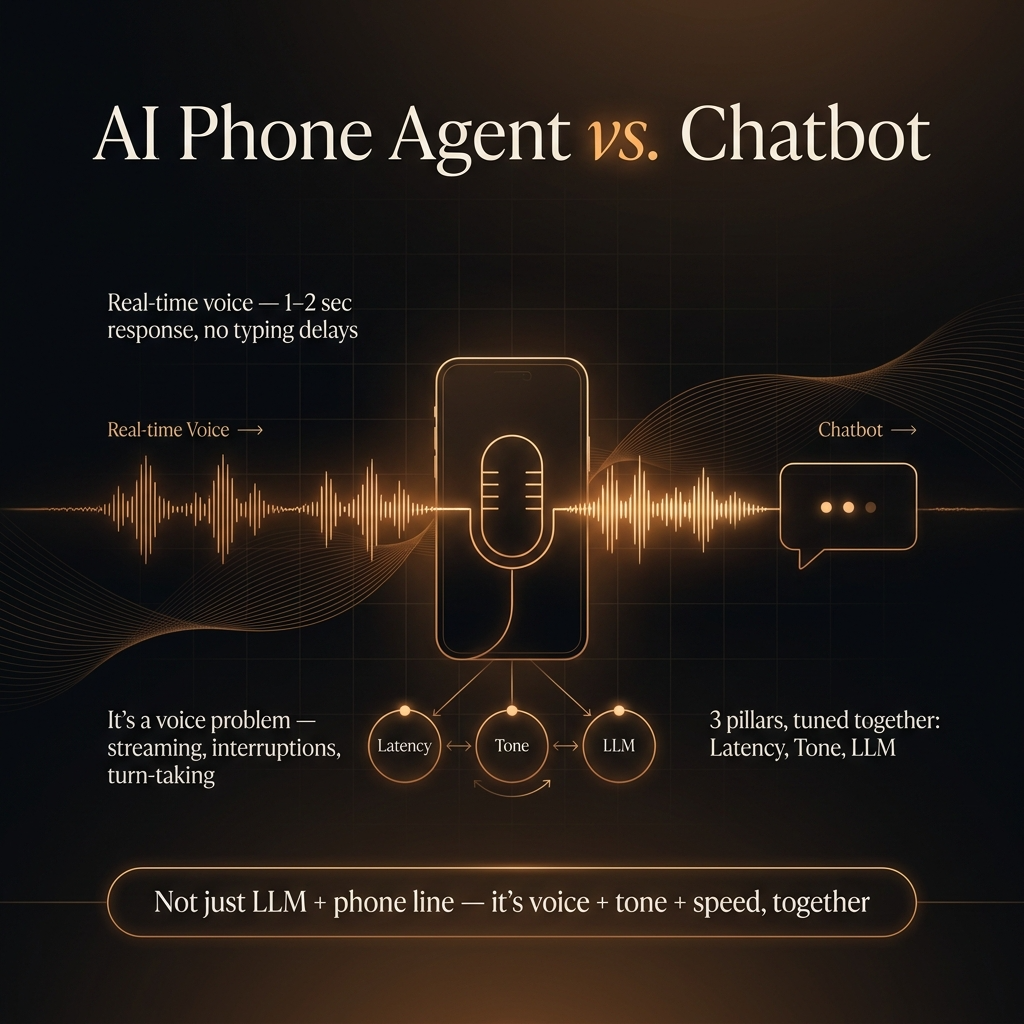
A conversational AI phone system works with voice, in real-time, without the pauses and delays that typing offers. No let me think of a phase. It must hear what the person says, make a response, and say it back within a second or two; otherwise, it sounds unnatural. In reality, much of what is an AI phone agent is a real-time voice problem.
Why Tone and Latency Decide the Experience
This is also a reason why, when answering the question “what is an AI phone agent?” you are not just plugging a large language model into the phone line. There is a need for all of these to work together, or the “real conversation” magic is lost. All three are addressed by a well-tuned conversational AI phone system.
How Does an AI Call Answering Agent Handle a Real Call?
A well-built AI call answering agent does more than respond. It manages the entire flow of the conversation from greeting to close, which is often the clearest day-to-day picture of what is an AI phone agent for a customer support team.
Managing the Flow of a Call
- Addressing the caller and understanding the caller’s intent in the first few seconds of the call.
- When a request is unclear, ask clarifying questions
- When the information for a particular account or order is needed during the call.
- Elevating to a human when out of its scope
- Ending the call with a definite next step or confirmation.
Knowing When to Step Back
The escalation step is more important than people think. An effective AI call answering agent will be aware of its capabilities and will gracefully respond to customers if they are frustrated by the bot and need to speak to a human agent, which is the most common pain point of IVR to begin with.
What Can an AI Voice Assistant for Calls Actually Do?
While an AI voice assistant for calls is still limited to FAQs, that’s just why many teams find themselves constantly returning to the question of what is an AI phone agent when it comes to new use cases.
Everyday Use Cases
- Making and changing appointments at a business that provides services such as a salon or clinic.
- Track orders and know their status in e-commerce and logistics.
- First-line technical support for solving simple issues before escalation.
- Qualifying leads for sales teams – gathering information ahead of the person going on the phone.
- After-hours coverage so that calls don’t directly go to voicemail at night time.
Where It Saves the Most Time
A high number of repetitive calls will be taken over by the AI voice assistant for calls, with staff focusing on those calls that truly require a decision. That is usually the most obvious and quantifiable response to the question ‘what is an AI phone agent worth to a business’.
What Should You Look for Before Choosing an AI Phone Agent?
Before adopting one, revisit what is an AI phone agent and what it can do in your specific industry, since not all systems are built the same.
A Practical Technical Checklist
- Integration depth: can it pull real data from your CRM, calendar, or ticketing system
- Escalation logic: does it know when to transfer to a human, and how smoothly
- Voice quality and latency: does it sound natural, or does it lag and talk over callers
- Customization: can it be trained on your specific scripts, tone, and edge cases
- Compliance: does it meet call recording and data privacy requirements for your industry
Running through this list is the most practical way to answer what is an AI phone agent going to look like once it is live in your business.
Questions Worth Asking Any Vendor
Ask directly how the vendor defines what is an AI phone agent within their own product, since the term gets used loosely across the industry.
Conclusion
Call handling is so much more than the days of boring and cumbersome phone menus. The companies that are still wondering, ” What is an AI phone agent? will be the ones that didn’t test them in time a year from now. For businesses with budgets that can’t afford missed calls or extended wait times, these systems are the norm for understanding real speech, engaging in true conversations, and adapting mid-call. However, this is not some new fad. The transition to smarter, more responsive call systems is already underway in businesses across all industries, and it’s the ones who are listening right now who will be best equipped to keep pace as customer expectations grow and grow for instant, natural communication.
Frequently Asked Questions
What is an AI phone agent?
It is a voice-based AI system that could answer calls, understand natural speech, and respond in natural speech, without a scripted menu, to perform tasks such as scheduling, support, routing, etc.
Is an AI phone agent the same as a chatbot?
No. Chatbots are based on text, and an AI-based phone agent is entirely voice-based and will be active in real-time. The question of what’s the difference between an AI phone agent and a text-based tool is essentially what everyone is asking when comparing the two, but the voice component alters the technology.
Can an AI phone agent replace human customer service completely?
Not all the way, but this is one of the things AI phone agents are good at versus transfers. It is good at serving up repetitive, high-volume queries, but it’s best to pass along complex or sensitive queries to a human agent for the best results.
Is AI phone agent technology expensive to set up?
It all depends on the provider and the number of calls that come in, but many companies find that the cost of such a service is ultimately worth the time saved in not losing calls, the staff reduction, and the quicker response times.