Online shoppers don’t want to deal with another support ticket. They want to raise a question verbally and find out the answer. This is where an AI voice agent for ecommerce comes in handy. Online retail is one of the sectors that is evolving at a rapid pace towards adopting AI voice agents, as they’ve gone from “new” to “needed” in less than 2 years. Put simply, it’s an automated, AI-powered telephone system that handles customer queries, monitors orders, recovers carts, and schedules appointments without any people to speak with on the other end. It’s no longer a trial for online stores operating on razor-thin profit margins – it’s a necessity. This change is no longer a novelty for online stores with thin profit margins; it’s a must for customers to be heard day or night, during the holiday season or the quiet Tuesday.
What Is an AI Voice Agent for Ecommerce?
AI voice agent for ecommerce is a software-based caller that listens and responds to customers as a trained agent, without the hold music or the roster of shifts. It connects to your store’s orders, product information, and knowledge base, and carries out real phone conversations, such as a customer asking “where is my package?” or someone comparing sizes to pick before they check out.
An AI voice agent for ecommerce is not a simple IVR menu that requires customers to press 1 or 2 on the phone, but rather one that understands what customers are saying and answers them in their own words. It’s not a “robotic phone tree”; it’s a “never takes a lunch break team member.”
How Do AI Voice Agents Work for Online Stores?
Behind the scenes, AI Voice Agents use three technologies: speech recognition to transcribe the speech into text, a language model to process the information and respond to the request, and finally text-to-speech to convert the response into a natural-sounding voice. Add a connection with your store back-end systems, and you have a voice bot that isn’t guessing; it’s pulling real-time order status, inventory counts, and customer history.
That is why, when an AI voice agent for eCommerce is deployed, it is different from a scripted phone bot. It’s not about memorizing lines; it’s about reasoning through a conversation, just as a good support person would, without having to nap for eight hours or get coffee.
Why Are AI Voice Agents for Businesses Becoming a 2026 Priority?
The economics here do not seem to be a matter for debate. Nearly 10% of contact center agent interactions will be automated, and the company’s forecasted total cost savings to agents increase. It’s not just a small roll-out; it’s a paradigm shift in AI voice agents for businesses being incorporated into the day-to-day interactions with customers.
The stress is mounting for ecommerce brands in particular. They want answers to questions, such as when the order will arrive, when it will be shipped, and when it will be returned, all answered IMMEDIATELY, not while the store is open. That’s where an AI voice agent for ecommerce steps in; the after-hours void that used to result in lost sales or customer disappointment and decision to go to the competitor’s live chat.
It’s not just the giants that are undergoing this change. AI voice agents for businesses are being used for the same reason: today, customers rate a business by the speed of its customer service response, not only on the products it offers.
What Can an AI Voice Agent for Ecommerce Actually Do?
The use cases are much more than “answering the phone,” and they can be adapted as much as they can be adapted for an AI voice agent on a small business as for a large enterprise catalog. A good AI voice agent for ecommerce should manage:
- Order tracking and delivery updates: Customers ask, agent gets the latest delivery data and responds instantaneously, no matter how long the wait.
- Call to action for cart: A simple voice reminder to a shopper to check out their cart, and to complete checkout immediately on the call.
- Product discovery/recommendation: Assisting an undecided shopper with sizing, comparisons, and/or bundle recommendations based on their question.
- Returns and exchanges: Explaining a returns policy to a customer, creating a label and/or booking a replacement order without moving the customer anywhere.
- Post-purchase upsells: Proposing a related product/service or a subscription service immediately after a support ticket is completed.
- Appointment and callback scheduling: Scheduling appointments with specialists for anything that the AI does not handle completely.
How Is Agentic Voice AI Different from Traditional Chatbots?
Text Chatbots: Wait for the user to type. Voice AI in the agentic mode listens, reasons, and takes actions, and can even complete multiple steps within a single call rather than bouncing a customer around menus. The important word here is “agentic” as it means that the system does not just “react” to a prompt; it can take initiative, retrieve data from a variety of systems, make a decision, and proceed on its own, such as booking a delivery slot or processing a refund without involving a human for every step along the way.
This is the advancement that brings AI voice agent for ecommerce to life, and not be a mere gimmick. A chatbot can inform you about the delay in the order. An agentic voice AI can let you know it’s delayed, offer to expedite it, and confirm the new delivery window all in one conversation.
Why Do Small Online Stores Need an AI Voice Agent for Small Business?
It’s an easy leap to think of voice AI systems for huge enterprise call centers having thousands of agents. This is no longer the case. An AI voice agent for small business is very much a necessity, because smaller teams don’t have the resources to maintain a 24/7 support centre. You can’t get a two-person ecommerce team working a Shopify store to answer a phone call at midnight—and that’s where a voice agent comes in handy.
With a small business, the reason why it’s valuable isn’t only because of its size; it’s because of not losing sales to something as preventable as not answering the telephone call. One ready-to-buy customer can get more than a month of voice agent running by just phoning in one time.
What Should You Look for in AI Voice Agent Software?
AI voice agent software isn’t created equal, and you’ll have a lot of frustrated, robotic-sounding calls if you select the wrong one. Selecting the right AI voice agent software is perhaps the most crucial choice to make when it comes to deciding whether the technology is an effective upgrade or another automated dead-end for your customers. When considering options, keep in mind the following:
- Natural, low-latency conversation: If there’s a noticeable pause before every response, customers notice and hang up. Sub-second response times matter more than most buyers realize.
- Multilingual capabilities: If your shoppers use more than one language, your AI voice agent for ecommerce should be the same – but not as a translator.
- Knowledge base grounding: The top AI voice agent software retrieves information from your product data and policies rather than churning out plausible-sounding guesses.
- No-code configuration: Teams without developers should be able to configure flows, voices, and business logic without coding.
- Seamless escalation to humans: Complex or emotionally charged calls should be seamlessly routed to a human, not stuck in a loop.
- Analytics and call insights: An AI voice agent for ecommerce continuously enhances itself as you grow, and it lets you know what customers are really asking.
What Are the Benefits of AI Voice Agents for Ecommerce?
The appeal isn’t just about saving money on staffing, though that’s part of it. AI voice agents for businesses selling online are seeing improvements across several fronts at once:
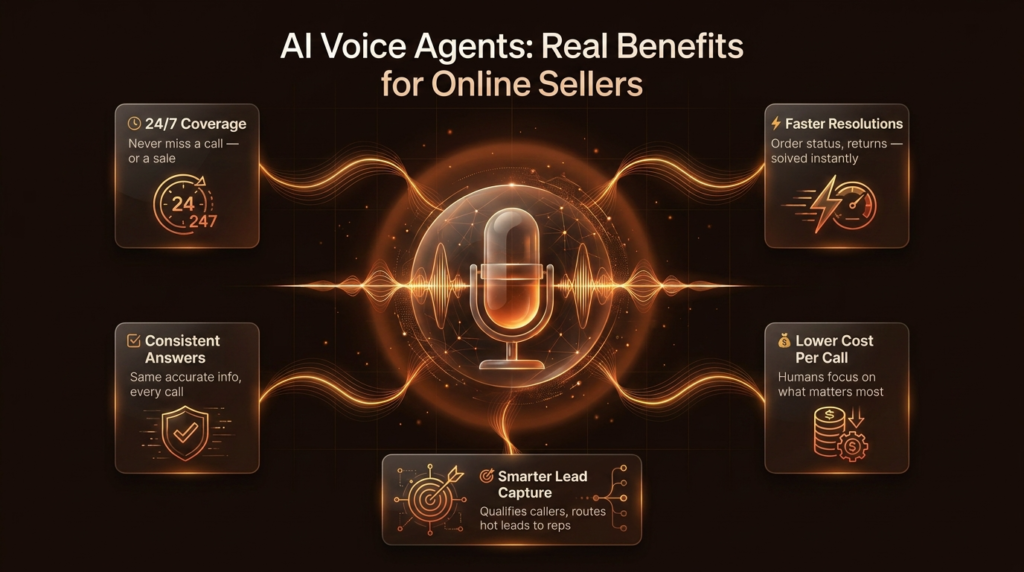
24/7 Coverage
No missed calls outside regular business hours, no lost sales due to a customer calling at the wrong time. This alone is often the deciding factor for an AI voice agent for small business owners weighing whether to make the switch.
Quicker Turnaround
If it’s a simple question, such as someone’s order status or whether they can return something, it can be resolved in one email thread rather than a round robin between the customer and your team.
Accurate, Consistent Answers
All callers receive the same correct information, rather than having to deal with a tired or new support rep. One of the main reasons is that they are consistent, even when compared to seasoned human teams, which leads to good customer satisfaction scores.
Less Cost per Interaction
Routine and repetitive questions take up human agent time, allowing them to focus on calls that require human decision-making.
More Effective Lead Capture
If your ecommerce brand needs to qualify leads, agentic voice AI can do that for inbound callers and send the serious ones directly to a rep.
How Does an AI Voice Agent for Ecommerce Compare to Hiring More Support Staff?
While adding agents to the roster makes up for the headcount, it doesn’t address the coverage problem; it’s the coverage problem agentic voice AI was created to address. No matter how many people you add to a team, gaps in coverage are built into the model, as human teams work in shifts, take breaks, and call in sick. An AI voice agent for ecommerce doesn’t take the place of your team; it fills in coverage gaps your team wasn’t designed to cover in the first place, such as receiving 2 AM order calls or a flurry of calls on a Sunday afternoon when nobody is on shift.
There’s a cost curve to consider, too. No new hires means no recruiting time, no weeks of training, no additional salaries. If they’re new hires, it takes time to recruit them, train them for weeks, and pay them for weeks that any of them call that day. An AI voice agent for ecommerce, on the other hand, can scale based on the volume of calls, whether that’s ten or ten thousand, without the need for a hiring plan to come before it. It does not imply that human agents are no longer required; there are still calls that are complex and involve a high price tag, and these calls still require a person. This translates to the fact that 70% of calls, those asking where my order is or how do I return this, cease to compete with your best reps for the available hours.
How Do You Get Started with an AI Voice Agent for Ecommerce?
The same goes for implementing an AI voice agent for small business; getting started doesn’t have to be a six-month IT project like it used to be. Most modern AI voice agent software allows you to integrate data from your store, select a voice and language, and be up and running with a working AI agent within minutes, not months. The most common deployment process is as follows: link your knowledge base and ordering system, validate your agent in real calls, improve the answers that it is able to give according to what the customers are asking, and roll it out to your support and sales lines. Since agentic voice AI can take multi-step action, this is where you’ll also determine what actions this AI can take without needing a human sign-off.
A one-time setup is not the best way for businesses to get the most out of it. It’s they who are using their AI voice agent for ecommerce as the equivalent of an active member of the support stack, constantly tweaking and adapting it, as customer queries change and call volumes provide insights on new patterns that should be automated.
It also helps to begin narrow. Instead of rolling out an AI voice agent for ecommerce in all lines at once, most teams start with one use case (order status calls or out-of-office support), test it out, and roll it out gradually into other ecommerce lines, such as cart recovery, returns, and outbound campaigns once it is consistently answering calls.
Conclusion
Ecommerce brands are no longer having to choose between excellent customer service and inexpensive customer service; now an AI voice agent for ecommerce is bridging the divide. This technology is closing conversations that previously slipped through the cracks – whether it’s answering an order enquiry at 2 am, following up on an abandoned cart, or qualifying a sales lead. Early movers are not just saving money—they’re creating a customer support experience that customers want. If your sales are being lost due to missed calls, delayed responses, or late-night lulls, it might be worth checking out how a voice agent can help with this at your store. Request a demo, run a trial with your actual customer queries, and watch how much it saves you!
Frequently Asked Questions
What is an AI voice agent for ecommerce used for?
It understands customer queries and answers their order enquiries, returns, recovering carts or answering product queries at any time of the day or night, without needing a human agent.
Are AI voice agents better than chatbots for online stores?
An AI voice agent for ecommerce can process multi-step, spoken requests naturally, whereas a chatbot is required to type a request. Voice can be more personal, evoke less of a robotic response, and often answer more complex questions in less time.
Can small businesses afford an AI voice agent?
Yes, Most of the AI voice agent software is scaled according to the volume of calls, so they can be used by small teams who are not able to have a phone support team 24 hours a day, but still keep all the calls. They won’t require a huge initial cost to pay for software licenses.
Is AI voice agent software difficult to set up?
No, Most modern platforms will allow for a no-code setup, allowing teams to put their data from their stores into the platform and be live in minutes without the need for a developer or a long technical onboarding process.