A multilingual AI voice agent is an AI-based voice system that can comprehend, process, and respond to customer calls in multiple languages, automatically and in real time. A modern multilingual AI voice agent can detect and respond to the caller in their native language in the same conversation, replacing the older language selection menus. In fact, this technology is gaining traction quickly among businesses that operate across regions, markets and time zones, which are looking to eliminate language barriers, reduce support costs and provide a consistent customer experience across their global footprint. A study predicts that contact center agent jobs will see an $80 billion reduction by 2026, with multilingual voice functionality at the heart of the change.
How Does a Multilingual AI Voice Agent Actually Work?
Having a grasp of the technology driving a multilingual AI voice agent will enable companies to make informed decisions when choosing platforms. It is not just a single tool; rather, it is a series of linked technologies that are operating in real time.
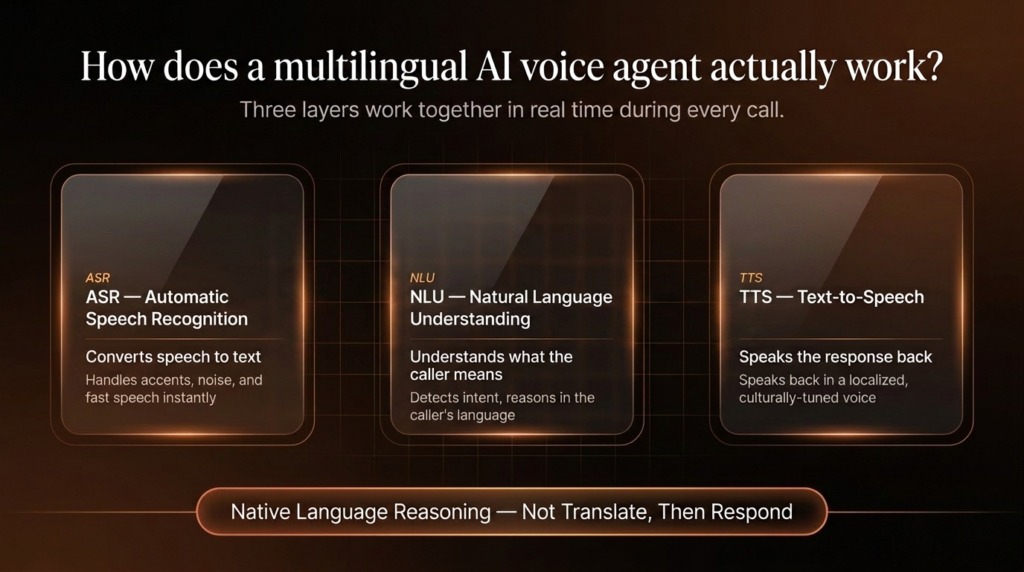
All systems that can function have three basic layers operating during a live call:
1. Automatic Speech Recognition (ASR)
The first one is to convert speech into print. ASR engines of a multilingual AI voice agent should be able to understand regional accents, background noise, high-speed speech, and dialects, rather than just studio-recorded speech. The top systems provide instant transcription, with a lag of just a few moments so your conversation doesn’t feel interrupted.
2. Natural Language Understanding (NLU)
After the speech is transcribed, NLU decodes the speech to determine what the caller actually intended to say. That is where intent detection and entity extraction take place. Strong AI voice agent language support: NLU model reasoning in the detected language or translation into the hub language with minimal loss of accuracy.
3. Text-to-Speech (TTS)
The agent’s voice is spoken in natural language in the caller’s voice. Most TTS engines today provide a localized voice, which can reflect the tone and formality expected during a service interaction, in terms of culture.
The difference between high- and low-performing systems is whether translation is native or bolt-on. Systems that reason in the customer’s language (and not translate English output) give quicker, more accurate, more natural responses.
Why Are Businesses Switching to Multilingual Customer Support Automation?
There is no argument to support multilingual customer support automation. There’s a limit to how far a multi-geography business can go when they need to hire bilingual employees for each language, each shift, and each market. There’s a cap on how far a business with multiple geographies can go when hiring bilingual employees for each language, each shift, and each market is either too expensive or too scalable.
Here’s what’s driving adoption right now:
- Language Coverage Gaps are Expensive. Each time an agent fails to convey a message due to language barriers, it is a potential customer or a problem that will eventually be issued to a person, which will cost more.
- Customer Expectations have Risen: Customers today want to know that they’re talking to someone who can communicate in their language and who will listen to and respond to them properly, not the next available Spanish-speaking representative on the “hold” line.
- Global Markets Move Faster than Hiring Cycles: A business can’t establish three new markets in a year and a day and hire and train native-speaking teams to support them. That’s eliminated by a multilingual AI voice agent.
- 24/7 Coverage is no Longer Optional: Midnight callers in Singapore must receive the same quality response as noon callers in Brazil. Voice AI is not based on shifts.
Multilingual customer support automation also helps the leaders of the contact center to handle fewer calls for escalation, increase the rate of FCR (first call resolution), and ensure that its quality is consistent, regardless of the language the caller speaks.
How Does Voice AI Handle Multiple Languages on a Single Call?
In a multilingual AI voice agent, this is where the detail of the operation comes in. The user’s experience is seamless when voice AI multiple languages capability is correctly implemented – meaning there is no menu for selecting a language, no lag time, and no transfer. What goes on behind the scenes:
- Language detection: The language being spoken is detected within the first 1 to 3 seconds of speech, even in cases of short speech in the form of a name or a greeting.
- Speech-to-text conversion: ASR models for that language are used to conduct speech-to-text conversion, taking into account accent variation.
- Intent recognition: NLU identifies what it is the caller wants to know and what data points are relevant to the call (account numbers, type of issue, product mentioned).
- Action execution: The agent executes a backend action such as checking the status of an order, creating a support ticket, or updating a CRM record, in the caller’s language context.
- Response generation: A natural, local response is vocally repeated from the caller without any noticeable delay in TTS.
- Human handoff with full context: Automatic handoff with full context to a live agent when an interaction is beyond the agent’s capacity, with the full transcript, detected language, and confidence scores included with it.
Most importantly, voice AI multiple languages support needs to address code-switching – that is, when customers speak two languages in one sentence. It is frequently found in multilingual markets such as India, Latin America, and Southeast Asia, and most off-the-shelf systems do not do well with this unless they are trained with it.
What Makes an AI Call Center Voice Agent Effective for Global Operations?
AI call center voice agent for international use is required to do more than just translate languages. In a multilingual AI voice agent, language is the input layer; subsequent actions determine the value of the interaction.
What Capabilities Should an AI Call Center Voice Agent Have?
As you assess platforms for contact center deployment, here are some must-have features:
- Native multilingual reasoning, rather than a translation-first architecture.
- The same language support is available in cross-channel consistency in voice, chat, email, and SMS.
- The integration seamlessly connects all back-end systems, including CRM, ticketing, and billing, to enable actions to be taken.
- Low end-to-end latency – response times < 2s for a natural conversational feel.
- Smart handoffs that include context, not just a call transfer, and confidence scoring and escalation logic.
- Performance monitoring per language, different dashboards with accuracy, escalation rate, and CSAT per language.
An AI call center voice agent that does these things, every time, is superior to one that adds translation to the top of an English-only AI logic.
How Does an Outbound AI Voice Agent Support Multilingual Business Goals?
There is a stronger emphasis in most discussions concerning multilingual AI voice agent technologies on inbound support. However, the outbound side of the equation is also crucial – and under-used.
An outbound AI voice agent handles proactive customer communication at scale. When that capability includes native language support, the results are measurably better:
- Patients/Customers who receive appointment reminders in their first language are more likely to confirm.
- Communication of payment follow-up in the customer’s preferred language minimises rudeness and awkwardness in the sensitive financial conversations.
- Answer rates and meaningful engagement are enhanced by lead qualification calls conducted in the local language.
- Rich feedback: Post-purchase follow-ups and satisfaction surveys yield more enriched feedback if customers respond in their own linguistic style
- Service notification, delays, outages, and shipping updates are more easily understood, and callback volume to the inbound is reduced when appropriate language is used.
An outbound AI voice agent that operates in multiple languages translates to an ability to operate proactive campaigns across 10 markets without having to have separate human teams in each language.
What Industries Benefit Most from AI Voice Agents for Customer Service?
Across sectors, AI voice agents for customer service with multilingual capability are removing language as a barrier to service quality. The industries seeing the sharpest impact include:
Retail and E-commerce
Tracking orders, returns, and delivery inquiries with customers in multiple countries is very repetitive and language-dependent. This volume is managed by a multilingual AI voice agent that works around the clock, without the need for human employees.
Banking and Financial Services
It is important to have financial conversations in accurate language. Balances, rates, or eligibility misunderstandings have real consequences. This is because AI voice agents for customer service should be capable of reasoning in every language, without needing to translate.
Healthcare
Clear communication is paramount with patients. Having appointments scheduled, getting medication reminders, and pre-procedure instructions in a person’s native language improves adherence and decreases no-shows.
Travel and Hospitality
Multilingual booking support, cancellation handling, and real-time updates for travelers across time zones are exactly what a well-deployed AI call center voice agent is built for.
Telecom
Serving diverse populations within a single country, often spanning dozens of languages and dialects, makes telecom one of the highest-impact use cases for multilingual customer support automation.
What Are the Common Challenges in Deploying a Multilingual AI Voice Agent?
However, businesses have real technical and operational challenges they must anticipate for the deployment of a multilingual AI voice agent at scale:
- Low-resource language gaps: less training data means less accurate transcription and intent recognition for languages.
- Dialect and accent variation: models trained on a single audio stream may not perform well if the stream is not representative of the language spoken in other regions of the country.
- Code-switching: mixing languages mid-sentence is common in multilingual markets and requires specialized handling.
- Latency management: every processing step takes time; badly designed pipelines cause awkward conversational gaps.
- Knowledge base maintenance: one source of the truth providing correct answers in all supported languages is more challenging than it seems.
- Compliance across jurisdictions: Data residency, consent to call recording, and GDPR equivalent regulations vary by country and need to be integrated in the deployment architecture.
These challenges are known ahead of time, so businesses can test vendors appropriately before signing a platform.
Final Thoughts: Why Multilingual Voice AI Is No Longer Optional for Global Businesses
Language barriers are not only a customer satisfaction issue, but they also impact revenue, retention, and operational costs. A multilingual AI voice agent does that at scale and enables businesses to provide customer service in their native language, on all channels, in all time zones, across all markets. The technology has matured to the extent that native multilingual reasoning, real-time language detection, and smart human handoffs can be done in production rather than just demos. With support from Analytic.ai, businesses can create and implement voice AI solutions tailored for real-world, multilingual deployment, from architecture to integration with current contact center software, ensuring a consistent and high-quality customer support experience across all languages.
Frequently Asked Questions
1. What is a multilingual AI voice agent?
A multilingual AI voice agent is an AI system designed to automatically recognize and answer customer calls in multiple languages without the need for human interpreters and providing accurate, real-time responses.
2. How does a multilingual AI voice agent detect language automatically?
Auto-Identifies the spoken language within the first few seconds of an incoming call – with automatic speech recognition trained across languages to identify the spoken language without manual intervention by the caller.
3. Can a multilingual AI voice agent handle code-switching mid-conversation?
Yes, advanced systems can do code-switching with mixed language ASR models and special training data, but the results are not guaranteed to be good by all vendors and language combinations.
4. What industries use multilingual AI voice agents most?
Retail, healthcare, banking, telecom, and travel are the most favoured sectors because they have large, linguistically diverse customer bases, where language barriers affect the quality of service and customer satisfaction.