Natural language understanding (NLU) is a subset of artificial intelligence that allows computers to comprehend the semantics, purpose, and background of natural language. It falls under the broader field of natural language processing (NLP), which is integral to numerous applications, including chatbots, voice assistants, search engines, and more. An NLU system doesn’t need to match a user’s words by word; instead, it must be able to discern what the user is trying to say even if the language doesn’t contain all the words or is not very precise. It’s this transition, from pattern matching to true understanding, that has propelled NLU out of the research lab and into more conventional products so quickly.
NLU vs NLP: What Is the Difference?
The terms of natural language processing and natural language understanding are sometimes used interchangeably, but they are actually two separate concepts. The techniques that allow computers to communicate with human language are all part of NLP and include tokenization, spell checking, translation, and text generation. The one piece of this umbrella that I will talk about here is comprehension – understanding intention, sentiment, and meaning from a sentence. Early understanding of NLU vs NLP differences prevents project engineers from being confused about the entire project.
NLU vs NLP vs NLG Briefly
A simple way to separate the three related terms:
- NLP is used for the decomposition of a text into its components, for grammar annotation, and for speech-to-text conversion, etc.
- Natural language understanding is involved in understanding the meaning – what does a person want, how does he feel, what should be done next?
- Another similar term, NLG, refers to the output side: returning a human-like response following the NLU processing of the input.
The Core Difference in Practice
In the case of the sentence “book me a table for two tomorrow night”, the voice assistant understands the meaning by breaking down the sentence structure (NLP) and the service intent (book a table), as well as the entities (two people, tomorrow, evening) it understands (NLU), and forwards the complete meaning downstream to any system that performs the booking. If there were no natural language understanding as the comprehension layer, then an assistant may be able to accurately transcribe the sentence but not understand how to use the information.
Natural Language Understanding vs LLM: What’s the Difference Explained?
The only reason for LLMs and natural language understanding getting confused is because they are so good at producing and interpreting natural language. They’re not interchangeable, however, and having NLU vs LLM explained is crucial for teams when choosing the right tool for the task.
The Overlap Between LLMs and NLU
Large Language Models (LLMs) are general-purpose models that are trained on large amounts of text data and used for predicting and generating text. Can write essays, summarize documents, and have open-ended conversations. NLU, in contrast, refers to a functional objective: to correctly identify the meaning, entities, and intent of an input, no matter what underlying technology is used to identify these.
Choosing the Right Approach for the Task
Many of the more modern systems rely on LLMs for their NLU layer, as transformer architecture models can process context and ambiguity much more effectively than previous rule-based methods. However, a system can attain high natural language understanding without using an LLM, instead using smaller, more focused models that are only trained to understand and classify intent or to identify entities. An LLM is more flexible, and a dedicated NLU layer can be more accurate and less latency for specific, predictable applications such as support ticket routing or voice commands on low-compute devices.
Market Growth Signals Rising Demand
According to the latest market research by Persistence Market Research, the total global natural language understanding (NLP) market is expected to reach approximately $25.6 billion by 2026 and reach $112.5 billion by 2033 due to the increased adoption of conversational AI and real-time language tools by enterprises. This growth is quite rapid, given the critical role that NLP plays in today’s software solutions.
How Does Natural Language Understanding Work?
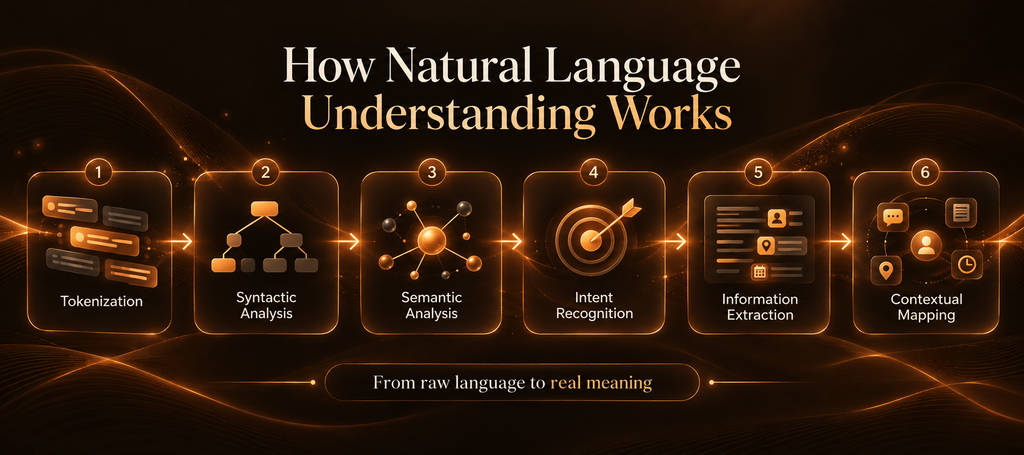
The process of natural language understanding is very rarely a single-step process but rather a series of layers. When processing language, most implementations are similar, but there are differences depending on the application and vendor.
The Core Pipeline Behind NLU
- Tokenizer/PPP: Text is tokenized into words or sub-words, noise is filtered out, and words are normalized.
- Syntactic analysis: The system analyzes the sentence to determine how the words in the sentence are related to one another.
- Semantic: This is the section that contains the meaning. The system links words and phrases to concepts, clarifying homonyms, and resolving the context.
- Intention recognition: The system recognizes the intention of the input, such as booking, complaining, and asking a question.
- Extracting information: These are pieces of information (dates, names, locations, product names, etc.) that are extracted and organized for future use.
- Contextual mapping: The system relates what it gets as input to the previous conversation and improves its understanding through the course of the conversation(s).
Transformer Models and Their Impact
The current NLU systems are mainly designed using transformer architecture and deep learning, which allows them to learn the relation between all words in the sentence, rather than analyzing them in a left-to-right fashion. This parallel context perspective is a key factor behind the context handling capabilities of today’s systems, compared to the previous rule-based systems.
What Role Do Automatic Speech Recognition and Text-to-Speech Play?
The applications being developed with voice need more than just understanding. This is where automatic speech recognition and text-to-speech come in to help them convert text to speech and speech to text.
Automatic Speech Recognition as the Input Layer
Automatic speech recognition turns spoken audio into written text, which is then fed to a natural language understanding system to interpret intent and meaning. Errors that occur at this point, such as mishearing a word when listening to an audio recording in a noisy environment, can come down the stream and affect the interpretation. Because accuracy here isn’t an add-on, it’s a core part of any voice experience to be reliable.
Text-to-Speech as the Output Layer
The other side of the pipeline is text-to-speech. The NLU picks up the request, and the output is what is written; when this is done, the NLU generates the appropriate response, which is then played back into a voice by the text-to-speech at the appropriate pace and intonation. Together, automatic speech recognition, natural language understanding, and text-to-speech will do the rest and help the voice assistant to sound more like a human than a menu-driven system.
How Is Natural Language Understanding Used in Chatbots and Voice Assistants?
The most popular and widely used application is the use of Natural Language Understanding for chatbots and voice assistants. When a customer asks a smart speaker for the weather, another person asks a question to a customer support bot, or dictates a text message on their phone. Natural language understanding is working in the background to interpret what they’re saying.
Common Use Cases in Customer Support
- Customer support automation: Chatbots will classify the query using NLU and transfer it to the proper workflow without human assistance.
- Sentiment-intelligent routing: A system can recognize the characteristics of a customer message that indicate that a customer is frustrated or urgent and then can pass it up to a human agent before it gets to the point of being a complaint.
- Multilingual support: By using natural language understanding, businesses can understand customer questions across different languages without needing separate sets of rules for each language.
Common Use Cases in Voice Assistants
In voice assistants, basic natural language understanding is used in different ways: to understand commands spoken by users, to understand the intent of voice input, and to carry out an appropriate action, such as setting a timer, playing a song, controlling a smart thermostat, etc. This implies that the more robust the underlying NLU the chatbot and voice assistant use, the less the user will have to repeat themselves, and that will translate into satisfaction scores and containment rates.
How Do You Measure NLU Accuracy and Evaluation Metrics?
Not every natural language understanding system is the same, and it is critical to measure them in the same way. NLU accuracy and evaluation metrics usually come in a small handful of core categories, which are tracked over time.
Core Metrics Teams Track
- Intent accuracy: The percentage of time NLU correctly identifies the user’s intent.
- Entity extraction F1 score: How to extract names, dates, and other structured information without compromising precision and recall.
- Confusion matrix analysis: A breakdown of which intents get mistaken for one another and is helpful to identify when training data overlaps.
- Confidence thresholds: When the system makes predictions that are not very confident, it either asks for clarification (a question) or provides a handoff to the human.
- Real-world containment rate: Percentage of conversations that are resolved without a human, showing NLU’s performance in real-world conditions.
Ongoing Evaluation as a Continuous Process
Natural language understanding systems are typically built using past data, so continuous evaluation is crucial. Language evolves, new slang emerges, and user behavior changes over time, meaning that teams that simply check off NLU accuracy and evaluation metrics are likely to find this metric dropping months later.
What Are the Best NLU Engines and Platforms Available Today?
The selection of the best NLU engines and platforms will depend on the specific use case, budget, and existing infrastructure. Generally speaking, there are a couple of different types of landscapes to be understood before they can be considered.
Types of NLU Platforms to Consider
- Cloud-based NLU services: Integrations provided by cloud service providers that include NLU with other AI tools, great for quick integration.
- Conversational AI platforms: Specialized platforms for chatbots and voice bots that are optimized to work alongside dialogue management and analytics.
- Open-source frameworks: Libraries that provide developers with greater control over training and customizing their own NLU models but require engineering resources.
- LLM-powered NLU: Newer platforms powered by large language models as their core engine with flexibility for different types of unscripted input.
Choosing the Right NLU Platform
The best NLU engines and platforms are not one-size-fits-all; it depends on the needs of a particular organization in terms of data privacy, conversation volume, supported languages, and the extent to which the organization can perform customization in-house.
Why Does Natural Language Understanding Matter for Businesses?
The benefits of natural language understanding aren’t just about the technology, but also the impact it has on key business indicators.
Impact on Support and Sales Teams
Natural language understanding is helpful to the support teams that use it to triage incoming support requests, as they’re faster to resolve simple requests because they don’t have to stand in line for routine ones. Natural language understanding allows sales and marketing to dedicate the time to clean, analyze, and detect patterns within the customer feedback that would otherwise take weeks to identify by analysts.
Impact on Accessibility and Global Reach
Another little-known benefit of natural language understanding is accessibility. Complementing voice interfaces, it helps users who don’t like to type or read small text communicate with software naturally, just by speaking. For international companies, however, NLP also reduces the need to develop specific support processes for each language in which customers use the company.
What Does the Future Hold for Natural Language Understanding?
The way is towards more context-aware, multilingual natural language understanding systems, which will be more embedded in normal software. In this way, natural language understanding is already moving beyond traditional one-on-one communication to multimodal systems that combine text, visual information, and speech. The applications of NLP in different customer service, healthcare, finance, and retail industries are growing, which means the demand for accurate and low-latency NLP will continue to rise across industries.
Conclusion
From customer service chatbots to home-controlled devices, the use of NLP is now becoming a part of everyday software use. It can help your team make informed decisions about which tools or platforms to use for your own specific applications by understanding the differences between natural language understanding and NLP and LLMs, building NLU step by step, and measuring the accuracy of NLP. As language technology keeps advancing, natural language understanding will likely become even more central to how humans and machines communicate, moving further away from rigid commands and closer to conversation that actually feels natural.
Frequently Asked Questions
What is natural language understanding in simple terms?
It’s the capability of computers to interpret the meaning and intent behind human speech – to add meaning to software beyond words or a collection of static phrases.
Is natural language understanding the same as natural language processing?
No, NLP is not an entire field of work; natural language understanding is the comprehension part of the task, in this case, to see what you want done, how you want it done, and the meaning of what you want done.
How is NLU used in everyday life?
It can be applied to power up voice assistants and chatbots, spam filters, search engines, and customer service systems to comprehend and react to what they hear.
Can natural language understanding handle multiple languages?
Yes. Many modern systems employ multilingual databases that can learn and understand the intent and meaning of the input, even when the input may be in several languages, without having to have multiple sets of rules for each language.