What do you mean “call containment”? The percentage of incoming calls that can be handled by an automated system (IVR, voice AI agent) and never require a human agent to intervene. It is tracked by teams as it directly relates to cost, wait times, and customer experience. The metric is increasingly gaining significance; by 2029, agentic AI will resolve 80% of the common customer service issues on its own, without any human intervention. The full guide to the definition, the formula, differences between deflection and escalation, what it should look like, and how to make it better.
What Is Call Containment and Why Does It Matter?
Each day, every call center is asked the same question: How many callers did not have to wait for a person to be available to receive the answer? Containment is the measurement used to answer that question, and it affects staffing, budgets, and callers’ patience at the same time.
A Plain Definition
Call containment is when a call is initiated and terminated within an automated channel. The caller could be paying a bill, checking an order, or booking an appointment, and the system takes the rest. Transfer, callback, or agent not applicable. So, what is call containment in practice? It’s not calls it just touched, but calls handled completely.
Why Contact Centers Track It
A phone channel is the most expensive element in a human system, and each time the automation system takes over a call, people can move on to more difficult conversations. If you ask any leader, “What is call containment?” most will answer you with cost and customer experience being at the top of the list. However, the number only has meaning when it is actually showing resolution.
How Do You Calculate Call Containment Rate?
The math is simple. The challenge is to determine what is contained. If you’re wrong, then the call containment rate you’re reporting will appear healthy, but your customers will be silently suffering.
The Basic Formula
The textbook answer to “what is call containment?” is one ratio:
Call containment rate = (calls resolved without a human agent ÷ total calls entering the automated system) × 100
Many teams also remove abandoned calls from the resolved count. That’s the safer method, because a caller who hangs up in frustration isn’t a success, even though no agent was involved. Define the time window too, such as calls per day or per month, so reports stay comparable.
A Worked Example
Take illustrative numbers. Say 10,000 calls reach your automated line in a month. Of those, 2,000 transfer to agents and 1,500 are abandoned before any outcome. That leaves 6,500 calls the automation truly handled, so the rate is 65%. Count the abandoned calls as contained and you’d report 80%, and that gap is where poor decisions start.
What Should Count as Contained
A call counts as contained when the caller’s goal was met inside automation. On its own, what is call containment really telling you? Not enough. Pair it with first contact resolution, repeat call rate, and CSAT so you can tell a solved problem from a caller who simply gave up.
What Is IVR, and How Does IVR Containment Rate Work?
Before measuring IVR performance, it helps to know what the system does. Most callers meet an IVR before they ever hear a human voice. That makes it the first place where the answer to “what is call containment?” gets tested.
IVR in Plain Terms
IVR stands for interactive voice response. It’s the phone technology that greets callers, reads out a menu, and reacts to keypad presses or spoken words. If you’ve ever pressed 2 for billing, you’ve used one. So what is IVR best at? Short, predictable tasks like balance checks and payment confirmations.
How IVR Containment Rate Is Calculated
IVR containment rate is the share of calls that finish inside the IVR without reaching an agent. It uses the same formula as the broader metric, but only for calls that entered the IVR. Long menus pull this number down, while a short, clear path for simple tasks pushes it up.
Why a High IVR Containment Rate Can Mislead
Callers who get lost in a menu often hang up. The system logs no transfer, so the call looks contained. A high IVR containment rate paired with rising repeat calls usually means people are escaping, failing. That’s why smart teams treat “what is call containment?” as a two-part question: was the call contained, and was the caller helped?
What Is Voice AI Containment Rate, and How Is It Different?
Voice AI agents understand natural speech, so callers can explain a problem in their own words instead of hunting through menus. That changes what’s possible, and it changes how containment should be read.
Voice AI Containment Rate Compared With IVR
Voice AI containment rate uses the same formula but often lands higher, because the system can handle more intents, interruptions, and follow-up questions. The better comparison is intent by intent. A voice agent that resolves password resets, order changes, and booking updates is doing different work than a menu that only reads out balances. The question “what is call containment?” gets a richer answer once voice agents replace menus: it becomes about completed tasks, not just completed calls.
What Shapes the Result
Several factors decide how well a voice agent performs:
- Speech recognition accuracy, especially with background noise and accents
- Response speed, since long pauses push callers to hang up or ask for a person
- Backend access, so the agent can complete tasks instead of only answering questions
- Clear handoff rules for cases it shouldn’t handle
Fixing the weakest of these usually lifts results more than adding new features.
What Is Call Deflection, and How Does It Differ From Containment?
These two terms get swapped constantly, and the mix-up leads to misleading reports. Both describe automation, but they measure different moments in the customer journey. Ask ten teams “what is call containment?” and how it differs from deflection, and you’ll hear ten different answers.
Deflection Explained
What is call deflection? It’s the practice of steering customers away from the phone queue toward another channel, such as a help center article, chatbot, or mobile app. The call never happens, or it ends early.
Call Deflection vs Containment at a Glance
Call deflection vs containment comes down to where the customer ends up. Deflection counts people redirected away from a call. Containment counts calls that stayed on the phone and were fully resolved by automation. A deflected customer might still phone in an hour later, while a well-contained call doesn’t need a second attempt.
Which One to Report
Report both, but never merge them. Deflection shows how well self-service channels reduce phone demand. Containment shows how the automated phone experience performs once someone does call. Think of deflection as the front door and containment as the room behind it. One tells you who stayed out of the queue, the other tells you who got helped once inside.
How Does Containment vs Escalation Rate Work?
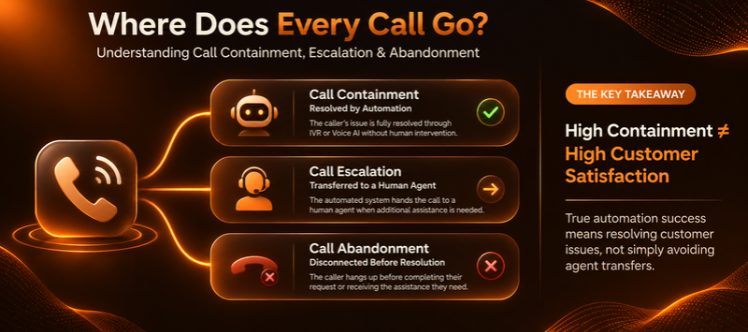
Containment and escalation are mirror images, though not perfect opposites. If “what is call containment?” asks how many calls succeed, escalation asks how many calls need help. Looking at both shows where an automated experience succeeds and where it hands off.
Containment vs Escalation Rate Explained
Escalation rate is the percentage of automated calls handed to a human agent. In theory, containment, escalation, and abandonment add up to 100%. Reading containment vs escalation rate together reveals where the system gives up and why. If you only ask “what is call containment?” and never ask what happened to the rest, you miss half the story. Tracking transfer reasons alongside the rate makes the picture far more useful.
Not Every Escalation Is a Failure
Some escalations are exactly right. A caller reporting a safety issue, disputing a large charge, or showing distress should reach a person fast. Chasing the highest possible containment backfires because hiding the exit raises the number while lowering satisfaction. A healthy system escalates the right calls quickly and contains the rest.
What Is a Good Containment Rate Benchmark?
Teams that ask “what is call containment?” usually follow up with “what’s a good number?” It’s a fair question, and the honest answer is that it depends.
Why One Containment Rate Benchmark Doesn’t Exist
A containment rate benchmark shifts with industry, call type, and technology. Published figures vary widely, and many come from vendors measuring their best-performing use cases. A bank’s fraud line and a pizza shop’s order line simply can’t be compared.
How to Set a Realistic Target
- Segment by intent, since balance checks contain far better than billing disputes
- Build your own baseline over 60 to 90 days
- Set separate goals for IVR and voice AI
- Pair every target with CSAT and repeat contact rate
A useful containment rate benchmark is your own history first and industry reports second. Review it quarterly, because new intents and better models will move the baseline. To answer “what is call containment worth?” in dollars, multiply the saving per contained call by monthly volume.
How Can You Improve Call Containment Without Hurting Customers?
Better containment should come from better service, not harder exits. Once your team agrees on “what is call containment?” for your business, these steps raise it by removing friction rather than hiding it.
Start With the Top Call Reasons
Pull a month of call data and rank intents by volume. The top handful usually cover most traffic. Automate those first, and make sure each flow can actually finish the task.
Fix the Handoff
When a call does need a person, pass along the caller’s details and the conversation so far. Nobody likes repeating themselves, and a smooth handoff protects satisfaction even when the call isn’t contained. Even the best answer to “what is call containment?” can’t rescue a clumsy transfer.
Review Failed Calls Weekly
Read transcripts of calls that ended in transfers or hang-ups. Patterns appear fast: a confusing prompt, a missing integration, an intent nobody planned for. Each fix lifts your call containment rate in a way that lasts, because it solves a real problem. Small, steady fixes beat dramatic overhauls.
Measure Outcomes, Not Just Rates
Track CSAT, repeat calls, and task completion beside the headline number. If the real goal behind “what is call containment?” is helping people quickly, the data should prove it.
What Is the Bottom Line on Call Containment?
Therefore, what is call containment? Well, this is the ratio of calls that your automation can completely solve, and it’s one of the most obvious indications of the quality of your phone experience. With its efficient use, it saves money and waiting time. When misused, it serves as a pretty face for aggravated callers. Compute it accurately, differentiate between IVR and voice AI, remember to consider deflection/escalation, and compare with your own call mix first. Correlate the number of containment figures with satisfaction and repeat call data to ensure the number is a true indicator of help. There is a lot of efficiency and trust that goes with measuring outcomes, not just transfers, and that’s what teams will gain as automation takes over more of the conversation.
What Questions Do People Ask Most About Call Containment?
What is call containment in simple terms?
Call Containment is the percentage of calls that an automated system (IVR or voice) resolves without transferring the caller to a human agent. The higher the rate, the lower the cost.
How do you calculate call containment rate?
Calculate the percentage of calls that are resolved without a human agent by dividing the number of calls that are resolved by the total number of calls entered into the automated system, then multiplying by 100. Only count resolved calls for accuracy, not abandoned calls.
What is the difference between call deflection and call containment?
Deflection sends customers down other channels, like chat or a help center, away from the phone. Call counts that are fully resolved by the automation, rather than a human agent, are included in the containment count.
What is a good containment rate benchmark?
There is no single number to determine the number of animals. Benchmarks are dependent on industry, call type, and technology, so compare against your own baseline intent and compare the figure with your CSAT and repeat contact rate.