What is word error rate (WER)? The most commonly used measure of speech-to-text accuracy is the word error rate (WER). It shows what percentage of words are missing, inserted, and mispronounced in the machine-generated transcript compared to a reference transcript that has been checked by a human ear and mouth. The formula for word error rate (WER) is WER = (S+D+I)/N, where N is the number of words in the reference, S is the number of substitutions, D is the number of deletions, and I is the number of insertions. A lower score indicates a more accurate transcript, and a score under 5% is deemed to be a strong score. It will describe what the word error rate is, what speech with low WER is like, and the limitations of the metric.
What Is Word Error Rate in Speech Recognition?
Speech recognition systems turn audio into text, and none of them gets every word right. Word error rate is the industry’s way of describing how often they miss. When someone asks what word error rate is, they’re really asking how many words a system gets wrong.
Understanding What Is Word Error Rate: The Three Error Types
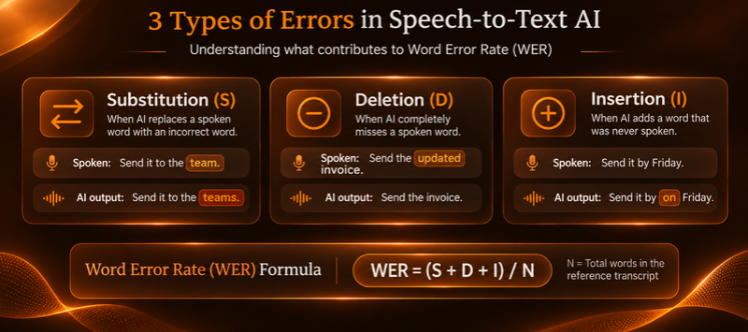
WER speech recognition scoring rests on three kinds of mistakes:
- Substitution (S): a word is swapped for a different one, such as “team” becoming “teams.”
- Deletion (D): a spoken word never makes it into the transcript.
- Insertion (I): the transcript contains a word nobody said.
Correct words cost nothing. Everything else counts, and each error weighs the same, whether it’s a stray “the” or a drug dosage.
Why WER Is the Standard for Speech-to-Text Accuracy
Before WER became common, teams had no agreed way to compare systems. Today it is the default measure of speech-to-text accuracy in research and vendor reports, which is why what is word error rate remains the first question in any speech-to-text evaluation.
Why Does WER Speech Recognition Accuracy Matter?
Speech-to-text is now used in call analytics, meeting notes, live captions, voice agents, and clinical documentation. If the transcript is incorrect, then everything created based on that transcript will carry this error.
How WER Affects Voice Products
Even a single misspelled word can affect sentiment analysis or misfire an automated process. It is forecasted $80 billion in global agent savings in contact centers in 2026 from conversational AI, but it is only when speech-to-text accuracy is reliable that that type of cost reduction is realized.
What a WER Score Tells You About a Vendor
Any vendor will start by bringing up a WER, but you need to know what the WER is telling you. It is a neutral score to assess all systems using the same audio, as long as reference transcripts are identical and there are matching text rules.
What Is the Word Error Rate Formula?
The word error rate formula is short, but every part matters. If you want to know what word error rate is at its mathematical core, start here.
The Four Values in the Formula
WER = (S + D + I) / N
- S = number of substitutions
- D = number of deletions
- I = number of insertions
- N = total words in the reference transcript
Every answer to what is word error rate comes back to the four values in the word error rate formula. A WER of 0.10 (10%) means roughly one in ten words needs a second look, and zero means a perfect match.
How Alignment Works Behind the Formula
Behind the word error rate formula sits an alignment step. The system must decide which output words line up with which reference words, using Levenshtein distance, a dynamic programming method that finds the fewest word-level edits between two transcripts. That alignment is the part of what is called word error rate that most people never see.
How to Calculate Word Error Rate Step by Step?
Once you know what word error rate is, learning how to calculate word error rate takes only minutes. The method is identical by hand or by script.
The Five Steps to Calculate WER
- Build a reference transcript. Have a person transcribe and verify the audio.
- Run the audio through your speech-to-text system to get the hypothesis.
- Normalize both texts. Lowercase everything, remove punctuation, and standardize numbers.
- Align the transcripts and count S, D, and I.
- Divide total errors by N.
A Worked Example With Real Numbers
This single sentence shows what is word error rate in action:
Reference: please send the updated invoice to the finance team by Friday (11 words)
Hypothesis: please send the invoice to the finance teams by on Friday
- “updated” is missing (D = 1)
- “team” became “teams” (S = 1)
- “on” was added (I = 1)
WER = (1 + 1 + 1) / 11 = 0.273, or 27.3%. Three small slips in a short sentence pushed the score above 27%.
How to Calculate Word Error Rate in Python
The open-source jiwer library handles alignment and counting for you.
python
from jiwer import wer
reference = “please send the updated invoice to the finance team by Friday”
hypothesis = “please send the invoice to the finance teams by on Friday”
print(wer(reference, hypothesis)) # 0.2727…
Normalize both strings first, or the score will reflect formatting rather than recognition quality. For most teams, what is word error rate in practice? Three counts and one division.
Can WER Go Above 100%?
Yes, and it surprises people who already know what is word error rate. Because WER counts every extra word as an error, the total can exceed the length of the reference.
Why Insertions Inflate the Score
A system that repeats itself or hallucinates text over a short clip can pass 100% easily. Even normal behavior can do it: if the reference says “I’m” and the system writes “I am,” that’s one substitution and one insertion against a single word.
What a WER Above 100% Means
That’s why asking what is word error rate in percentage terms is doesn’t always give a tidy answer between 0 and 100. Treat anything above 100% as a sign of runaway insertions.
What Counts as Low WER Speech Recognition Performance?
There’s no universal target, because the right number depends on the job. Once you understand what is word error rate, the next question is how low is low enough.
Common WER Benchmarks by Use Case
A commonly cited benchmark is under 5% for general use. Medical and legal transcription need to go well below that, since one wrong word can change a record. A score of 3% only means something once you know what is word error rate measuring and on which audio.
How Does WER vs Accuracy Differ?
The WER vs accuracy question comes up in nearly every evaluation. A common mix-up when learning what is word error rate is reading it as an accuracy score.
Accuracy Is Not Simply 100% Minus WER
Many dashboards subtract WER from 100%, so 8% becomes “92% accurate.” It’s handy shorthand, but not strictly right, because accuracy stays between 0 and 100% while WER doesn’t.
The Meaning Gap Behind WER vs Accuracy
The deeper WER vs accuracy gap is about meaning. WER only measures string matches, so two transcripts can share a score and differ wildly in usefulness. Ask what is word error rate hiding here, and the answer is meaning.
What Affects Speech-to-Text Accuracy?
People who ask what is word error rate often assume the score belongs to the model alone. It doesn’t, because audio, speakers, and text rules all push it up or down.
Audio and Speaker Factors
- Audio quality: noise, echo, and compressed phone lines raise errors fast.
- Accents and dialects: training a system primarily from a single accent makes it difficult to handle other accents.
- Overlapping speech: when people talk over each other.
- Speaking pace: very fast speech is difficult to transcribe.
Vocabulary and Normalization Factors
- Domain vocabulary: product names, drug names, and acronyms are common substitution targets.
- Language: most public benchmarks are based on English and therefore may not reflect the performance of other languages.
- Text normalization: “twenty five,” “25,” and “twenty-five” are considered to be three separate words without normalization.
Normalization is the quiet culprit behind many disputed benchmarks, because two teams can score the same model on the same audio and publish different numbers.
What Are the Limits of WER, and What Are the Alternatives?
Everyone interested in word error rate should also know where it breaks. WER is a blunt instrument and is good for comparison, but not for quality judgments.
Where WER Falls Short
It is the same for any error, disregards meaning, and doesn’t mention punctuation or speaker labels. Even with a low score, there may be a real problem; with low WER, speech recognition still has to be checked by a human.
Metrics That Complement WER
- Character error rate (CER): operates on the character level, appropriate for languages with no word boundaries.
- Match error rate (MER): compares the number of errors to the number of matched & erroneous words.
- Word information lost (WIL): estimates of word information lost in transcription.
- Semantic and human-evaluated measures: measures that detect if the meaning and the readability are preserved, e.g., HEWER.
There is no definitive metric to answer what is word error rate missing, so use it with other metrics and read a sample of actual errors.
How Can You Lower WER?
Knowing what is word error rate is useful, but lowering it is where the work starts. Most gains come from better inputs and better testing, not just a bigger model.
Improving Audio and Vocabulary
- Improve the audio. Better microphones and noise suppression help before any model tuning.
- Add custom vocabulary. Many speech-to-text systems accept keyword lists that target names and jargon.
Testing and Tracking WER
- Test on your own audio. Public leader boards are a starting point, not the finish line.
- Review errors by type. Many deletions point to audio problems. Many substitutions point to vocabulary or accents.
- Track WER over time. Remember what is word error rate counts: errors against a reference, nothing more.
How Should You Benchmark Speech to Text Providers?
A fair comparison takes discipline, and that is where what is word error rate stops being a definition and becomes a decision tool.
A Fair Vendor Comparison in Six Steps
- Collect representative audio, including the messy parts.
- Create human-verified reference transcripts.
- Run every provider on the same files with the same settings.
- Normalize all outputs with identical rules.
- Score everything with the same tool.
- Read the errors by hand, not only the totals.
If two vendors quote different numbers, ask for their normalization rules before you trust either. And ask what is word error rate on your own audio, not just on the leader board.
Final Thoughts
Word error rate is a fast and reliable measure of the accuracy of speech-to-text: the number of substitutions, deletions, and insertions, divided by the number of words in the reference. Easy to compute and can be used to compare any two systems. But it is used to measure text matching, NOT meaning. A bad WER does not necessarily mean that your audio will be a bad one and vice versa. Use WER, carefully normalize your text, test using real recordings, and read the errors. Once you understand the meaning of error rate, and what it is hiding, you’re ready to choose and tune speech recognition systems with confidence.
FAQ’s About WER
What is word error rate in simple terms?
WER: the number of words that are incorrect for a speech to text system over the number of words for a human reference system. It counts additions, deletions, and insertions and then divides by the number of words in the reference.
What is a good WER for speech recognition?
The standard to follow is less than 5%, which is used for general purposes. The required scores are much lower for medical and legal work, and the appropriate target will depend upon the skills of the audio ability, word power, and risk-taking ability.
How do you calculate word error rate?
Edit the text by adding, deleting, and substituting words, and then partition into words in the reference text. Multiply by 100 to obtain a percentage. If you make three mistakes in 11 words, this is 27.3%.
Can WER be higher than 100%?
Yes. Errors can count more than the number of reference errors, since additions of words will be made when making insertions. The system can keep generating or creating text beyond 100% WER.