Calls are flooding in front desks. During high-traffic hours, most clinics receive the same types of appointment requests, rescheduling, insurance questions, and no-show follow-ups, and they lose a huge percentage of appointments during these periods. This is where an AI voice agent for clinics comes in, moving from a good-to-have to a standard part of infrastructure. It’s software that listens to the phone, comprehends natural speech, and manages regular patient interactions without any human interaction. This change is supported by real numbers, as the global AI voice agents in healthcare market is forecasted to reach USD 3,175.9 million by 2030 from USD 876.2 million in 2026, growing at a 37.8% CAGR. How it works and what to look for before selecting one.
What Are AI Voice Agents for Healthcare, and How Do They Work?
On a fundamental level, AI-powered healthcare voice agents rely on three key technologies: speech recognition, NLP, and TTS. Fundamentally, AI-powered healthcare voice agents depend on three technologies: speech recognition, natural language understanding, and TTS. Integrated with a clinic’s scheduling system and EHR, you have a voice calling AI agent for healthcare that can book, cancel, and move appointments, check insurance details, and answer common pre-visit questions, all without a staff member touching the phone.
Whereas the traditional IVR (“press 1 for billing”) is replaced by a modern voice AI agents health care that converses. You can tell the system, “I need to change my appointment to next week, Thursday,” and the system will understand, check it out, and confirm, just like a front-desk coordinator would. The underlying models have also improved greatly at dealing with accents, background noise, and interruptions, which is why adoption has grown so rapidly over the past year, rather than coming to a halt as earlier voice-bot attempts did.
Why Are Clinics Adopting an AI Voice Agent for Clinics So Quickly?
A few forces are converging at once:
- Call volumes continue to increase while the number of people at the front desk remains unchanged, particularly for multi-location practices.
- Patients expect 24/7 access. There is no need for business hours anymore to book a table or a cab anymore and healthcare is catching up.
- Missed calls cost revenue. Each call that isn’t answered is an unbooked appointment, and it’s likely a patient who called another clinic instead.
- Burnout is a serious issue among staff. Having the front desk free of repetitive scheduling calls allows them to concentrate on those who come into the building.
Hence, an AI voice agent for clinics is being seen more as an integral part of the infrastructure and not an experiment. This is why an AI voice agent for healthcare is being seen as more than an experiment, and more, as an integral part of the healthcare infrastructure.
How Does an AI Voice Agent for Clinics Handle a Real Patient Call?
Here’s a simplified walkthrough of what happens when a patient calls a clinic running voice AI:
- No hold music and no queues; the call is answered immediately.
- The system welcomes the patient and inquires about the reason for the call.
- Speech-to-text and intent match (booking, rescheduling, prescription refill, billing question, general inquiry).
- The agent looks at the live calendar of the clinic and provides the available appointment slots.
- The patient confirms, and the system reserves that appointment straight in the practice management software and sends a confirmation text/email message.
- If it’s not something it can deal with (a clinical question, for example), the call is directed to a human staff member who already has a full context logged.
That latter fact is important. An effective AI voice agent for clinics is not meant to substitute clinical judgment; it’s intended to eliminate the administrative clutter and enable employees to concentrate on what requires a human.
What Makes Voice AI Agents Health Care Different from a Chatbot?
Chatbots need a patient to open an app or website and type. Voice AI agents health care work over the phone — the channel patients already default to, especially older populations and anyone calling urgently. Voice also carries tone and urgency that text strips out, which is one reason healthcare providers are prioritizing an AI voice agent for healthcare over chat-only tools this year. For a clinic, that means fewer barriers between a patient’s intent and an actual booked appointment.
What Are the Core Benefits of an AI Voice Agent for Clinics?
No missed calls: All calls are answered, even after hours and on weekends.
- Reduced no-shows: Reminder calls with automation and simple rescheduling reduce empty seats.
- Less admin work: Time saved by front desk staff in repetitive scheduling is spent on in-person patient experience.
- Reduced administrative load: Front-desk staff spend less time on repetitive scheduling and more on in-person patient experience.
- Consistent patient experience: Every caller gets the same accurate, polite, on-brand interaction, regardless of call volume or time of day.
- Faster intake: Basic patient information and insurance details are taken before the visit to aid faster intake.
- Scalability: One AI voice agent for clinics can deal with dozens of calls at one time, something that a front desk team can’t during rush hour.
- Improved data capture: All calls are captured the same way, providing clinics with clean data regarding call reasons, peak hours, and conversion from call to booked visit – data which is difficult to accurately gather from manual call books.
Overall, these advantages are the reason why an AI voice agent for clinics is likely to start saving bookings within a shorter span of time than any other benefit, even before staff-time savings are taken into account.
How Do AI Voice Agent Services for Businesses Apply to Small and Multi-Location Clinics?
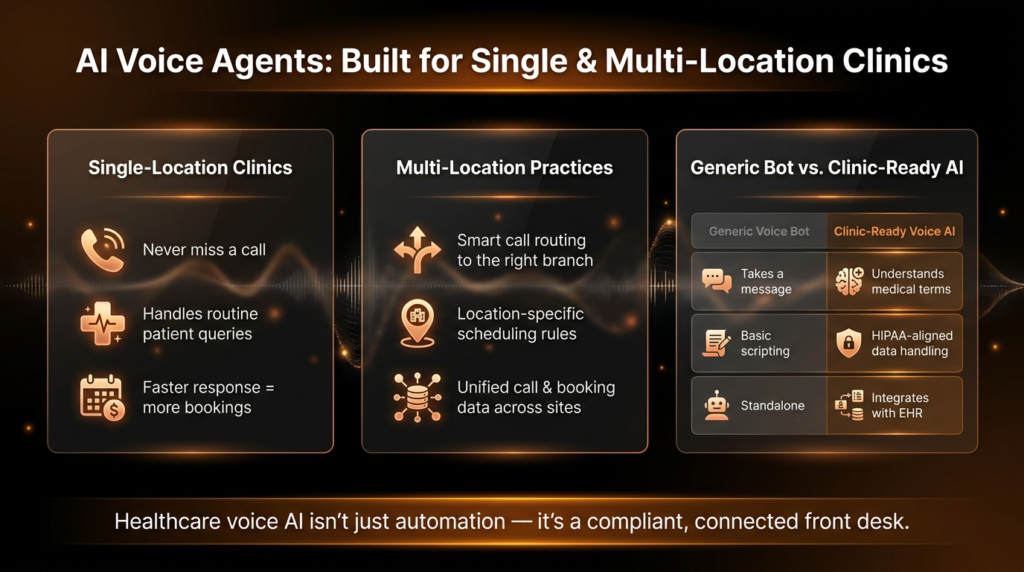
AI voice agent services for businesses were originally built for retail and call centers, but healthcare has become one of the fastest-growing use cases because the pain points line up so closely: high call volume, repetitive queries, and a direct link between response speed and revenue. For a single-location clinic, an AI voice agent for clinics means the phone never goes unanswered. For multi-location practices, the same system can route calls to the correct branch, apply location-specific scheduling rules, and give leadership a single view of call and booking data across every site.
This is also where the line between generic AI voice agent services and healthcare-specific voice AI blurs. A generic voice bot can take a message. A clinic-ready system needs to understand medical terminology, follow HIPAA-aligned data handling, and integrate with the practice’s existing EHR, which is a materially different build.
What Should Clinics Look for in AI Voice Agent Services?
Not all providers are created equal. There are a few things to consider when selecting an AI voice agent for clinics:
- Compliance with HIPAA, proper documentation of data storage practices, and security measures.
- Integration with native EHR and scheduling systems, not a bolt-on that needs to be synced manually.
- Good, natural conversation quality – patients get bored of robotic quality.
- Multilingual support, particularly for practices with a diverse patient population.
- Logic to escalate complex/clinical questions to humans while retaining context.
- Clear and accurate reporting of call volume, booking conversion, and missed call recovery.
How Is an AI Voice Agent for Clinics Different from Hiring More Front-Desk Staff?
Staffing up to a certain extent is useful, but no more; when you add staff, you have to pay them a salary, which comes out of the business again and again. Clinics don’t need an AI voice agent to take the place of the front desk; it frees up the time of the front desk staff so they can focus on the more creative part of their job, away from a hundred routine calls each day. It covers evenings, weekends, and holidays without overtime, and when the phone starts ringing more than usual- flu season, a new practice location, a marketing campaign no longer have to wait on hold. That’s frequently a more sustainable approach for growing practices than a constant increase of staff to catch up with the phone.
What Results Can Clinics Expect After Adopting an AI Voice Agent for Clinics?
It will depend on clinic size, specialty, and number of calls received, and any numbers should be taken as a rough guide rather than a fixed figure. In general, the pattern observed in the pattern clinics is that fewer calls are not answered after implementing an AI voice agent for clinics, a marked reduction in no-shows after implementing automated reminders and convenient rescheduling options, and fewer repetitive scheduling calls by front-desk staff. If you’re looking for the biggest single factor, then full EHR and calendar integration is the most important: One voice agent with live availability and calendar booking can close the call in one call; another that merely takes a message simply moves the call.
How Long Does It Take to Deploy an AI Voice Agent for Clinics?
The time needed for a timeline is based on the customization level required for a clinic. A standalone AI voice agent for clinics with a straightforward scheduling setup can often go live within a few weeks. Those practices that require more extensive integration into EHRs, multilocational routing, or multilingual capabilities are likely to take longer to deploy, as these will require additional testing prior to the system being able to manage real patient interactions. Regardless of which route you take, most providers suggest using a “phased” approach, beginning with answering calls and setting appointments, then adding reminders, intake, and reporting once the basic flow is established.
Frequently Asked Questions
What is an AI voice agent for clinics?
It’s an automatic software answering the clinic phone that can be programmed to understand natural speech and to take care of any need that the clinic may have, such as booking, rescheduling, and answering basic patient inquiries with ease and without a receptionist on the line.
How do AI voice agents for healthcare reduce missed appointments?
They place calls or send texts to patients before visits, have a one-step rescheduling process, and automatically confirm patient attendance, which would otherwise be left open by manual calls to remind patients.
Are AI voice agents for clinics secure and HIPAA compliant?
Trustworthy providers integrate data handling, encryption, and access protocols into the system that comply with HIPAA regulations. Don’t take compliance documentation for granted when you select a patient-facing call vendor.
How much does it cost to implement an AI voice agent for a clinic?
The pricing is dependent on the volume of calls, integrations, and customization requirements. Most vendors have tiered pricing, so clinics begin with a limited amount of usage and increase as results are realized.
Final Thoughts
Clinics don’t have to transform their entire workflow to reap the rewards of voice AI, most begin with one challenge, such as missed calls, scheduling delays, or no-shows, and build up from there. Clinics that use an AI voice agent don’t replace the front desk; they ensure every patient call is answered on time, every time, and provide staff with more time to focus on patient care. The earlier a clinic moves, the greater the satisfaction and revenue recovery enjoyed by the patients. If you are considering voice AI as a potential enhancement to your practice, first identify the problem areas for missed calls in your business – typically, they are where it will make the quickest ROI.